Motorcycle laws: emissions, exhaust, lane splitting and Texas
If you’re like me, imagine you bought a nice exhaust online, with a sound you loved in the video. Two weeks later a police officer pulls you over for something else, looks at the pipe and can’t find any label. Or you move to another state with your bike and find out that what was legal in one isn’t legal in the other.
Motorcycle laws change by country, by state and even by city, and the press often mixes proposals with laws that are in force. Here we separate what’s in force from what’s still only a proposal, with the source and the date we checked: October 2026. This doesn’t replace your state’s official text; it helps you know what to ask and where to look.
In short: Removing emissions controls violates U.S. federal law · Replacement exhausts must carry an EPA noise label (80 dBA for 1986 and later motorcycles) · Full lane splitting is legal only in California; five other states allow variants with speed limits · In Texas, lane splitting and filtering are prohibited, and helmets are required with some exceptions · In Mexico City you may ride between lanes only when traffic is stopped · Mexico’s emissions standard for new motorcycles is still a proposal.
Motorcycle emissions laws in the U.S.: certified, and no removing parts
Let’s start with this: every new motorcycle sold in the U.S. for street use must have an EPA certificate of conformity; the manufacturer gets it for each engine family and model year under 40 CFR Part 86 (subparts E and F). For you, as the owner, the other part matters: the Clean Air Act prohibits removing or rendering inoperative an emissions control device after the sale, and prohibits making, selling or installing parts whose principal effect is to defeat it. That’s section 203, which you can read at 42 U.S.C. 7522.
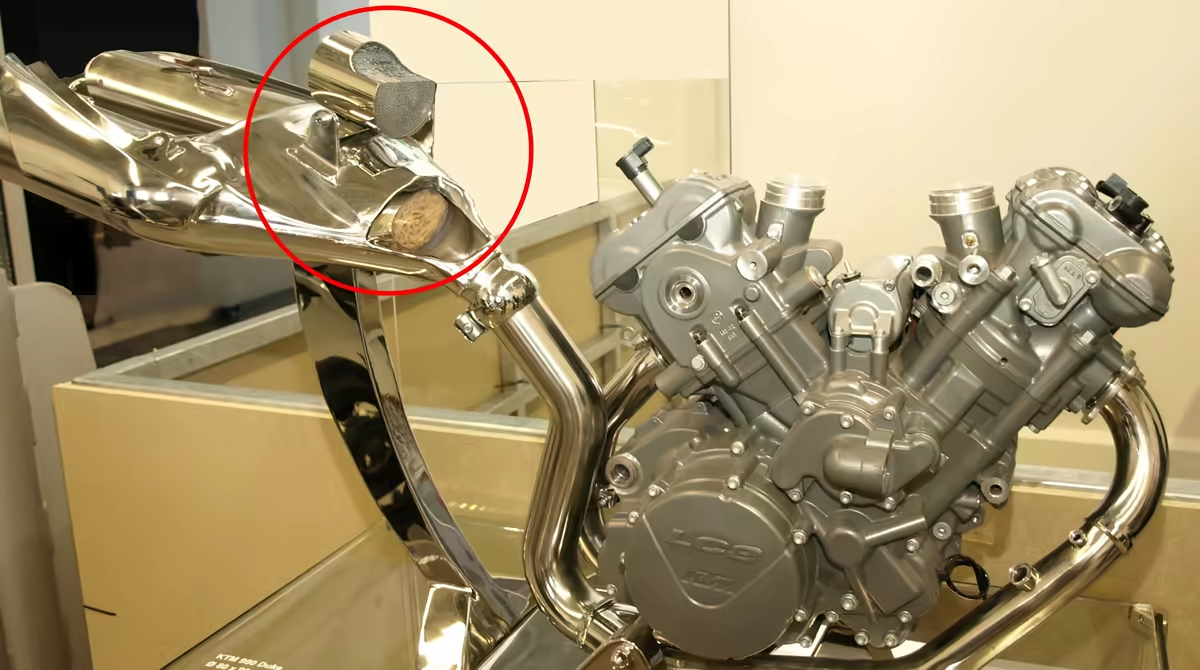
Translated to the garage: the catalytic converter, the oxygen sensors, the secondary air valve and the evaporative canister aren’t decorations. Removing them, bypassing them or “deleting” them with a tuner is tampering with emissions, and that’s where you can get in trouble. The EPA has said it prioritizes the people who make or sell these devices and the shops that install them, but the prohibition applies to everyone. Its tolerance for motorcycles permanently converted to competition-only use is an enforcement policy, not a permission, and it doesn’t cover your daily rider.
California, CARB and the difference between a “California model” and a “49-state” model
California has its own regulator, CARB, and its own certificate. Before a new motorcycle can enter California commerce for street use, CARB must first issue an Executive Order for that make, model and year; that’s how CARB’s motorcycle certification page explains it. That’s where the distinction you’ll see in spec sheets and listings comes from:
- “49-state” model: meets EPA rules but has no CARB Executive Order. It’s sold new in every state except California.
- “California” or “CA” model: has the Executive Order, usually with extra evaporative control equipment, and can be sold new in all 50.
Before you buy a new motorcycle, ask which version it is. If you plan to bring one from another state into California, check with the California DMV: we couldn’t document the registration requirements here.
About the future: in 2023 and 2024 CARB was developing a major overhaul of its on-road motorcycle rules: bringing them closer to Euro 5, tightening evaporative controls, requiring on-board diagnostics and setting a growing share of electric motorcycles starting with model year 2028 or 2029, depending on the draft. As of October 2026, the CARB pages we checked still show the 2010 exhaust standards and the 2015 evaporative standards as current, and the press reported that the 2024 vote was postponed. If someone tells you there’s already a “Tier 4” or an electric quota in force, we couldn’t confirm it: treat it as a proposal until you see the published regulation.
Euro 5 and global-catalog motorcycles
In Europe, new motorcycles have had to meet Euro 4 since 2016 and Euro 5 since 2020, as CARB itself summarizes. Manufacturers prefer a global motorcycle that meets the strictest rules, so many models that reach the Americas come with more sophisticated catalytic converters and diagnostics. In the press you’ll see “Euro 5+”, an informal name for a stricter stage of Euro 5; here we stick with Euro 5, which is what the official sources we checked cite.
Mexico: what’s a standard and what’s a proposal
For motorcycles already on the road, Mexico has had NOM-048-SEMARNAT-1993 since 1993, with limits for hydrocarbons, carbon monoxide and smoke; the official standards catalog of the Ministry of Economy lists it as in force. In Mexico City, the emissions testing program for the second half of 2025 exempted motorcycles, and El Universal explained in May 2026 that there’s a bill in the city’s Congress to include them, with no official confirmation. We couldn’t confirm anything for the State of Mexico, so we don’t claim anything: check with its environmental authority.
In April 2026 Semarnat, Mexico’s environment ministry, published the draft standard PROY-NOM-175-SEMARNAT-2026 in the Diario Oficial, on emission limits for new gasoline motorcycles, with public comment open until June 21, 2026, according to UnoTV. A draft isn’t a standard: it isn’t binding until the final version is published, and we didn’t find that this has happened.
Where the industry is heading
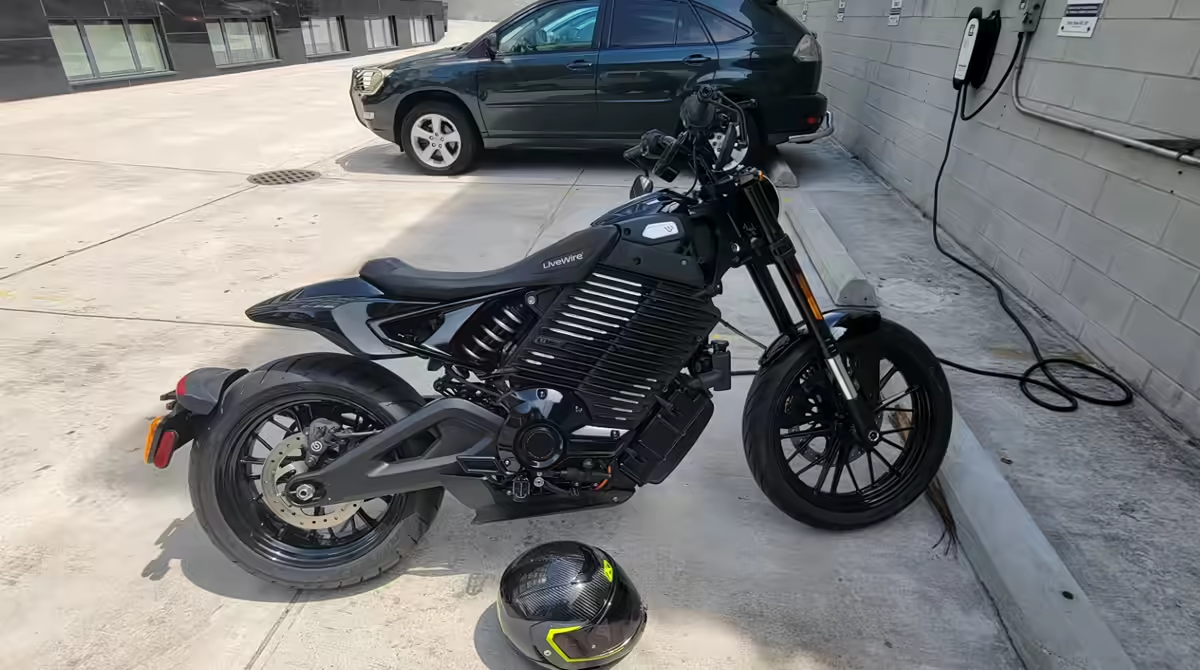
The pressure comes from two sides: stricter global standards and electric motorcycles. CARB notes that several zero-emission models are already on sale in California, that some qualify for incentives and that its long-term scenarios include a transition toward them; also, these motorcycles don’t go through the Executive Order process for combustion models. For the everyday rider the takeaway is simple: if you buy a gas motorcycle, make sure it’s properly certified and complete, because that protects its resale value and your legal peace of mind.
Motorcycle noise and exhaust laws: the label almost nobody checks
What the federal standard says
The EPA regulates noise from new motorcycles in 40 CFR Part 205. For street motorcycles the limit is 83 dBA for 1983 models and 80 dBA for 1986 and later models; off-road motorcycles have their own limits based on engine size. It’s a certification limit for the new product, not a number they ticket you with on the street. The manufacturer must also put a label on the motorcycle warning that modifications that make it exceed the standard are prohibited by federal law.
If you ride on dirt, trails have their own noise rules; we cover them in our off-road trail ethics guide.
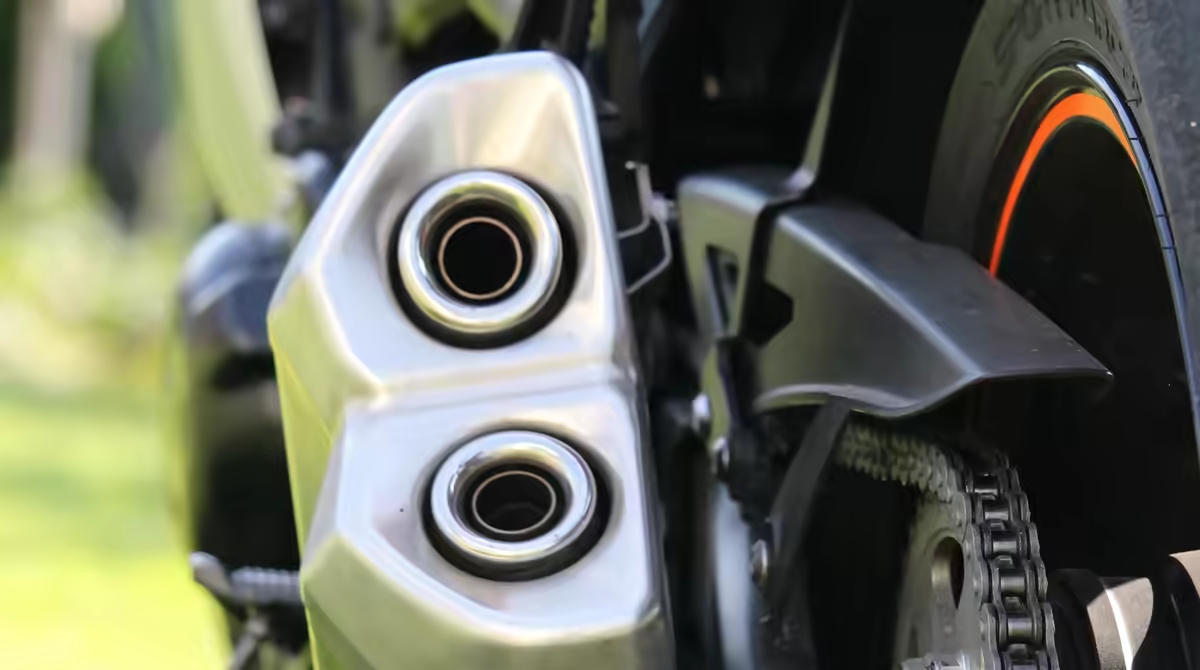
The label on replacement exhausts
Here’s the useful part. Section 40 CFR 205.169 requires replacement exhausts to carry a label headed “Motorcycle Exhaust System Noise Emission Control Information”, a statement that they meet EPA noise requirements (with the decibels) and the list of model codes they fit. It warns that installing it on other models may violate federal law. Those made in the U.S. only for export carry the legend “For Export Only”.
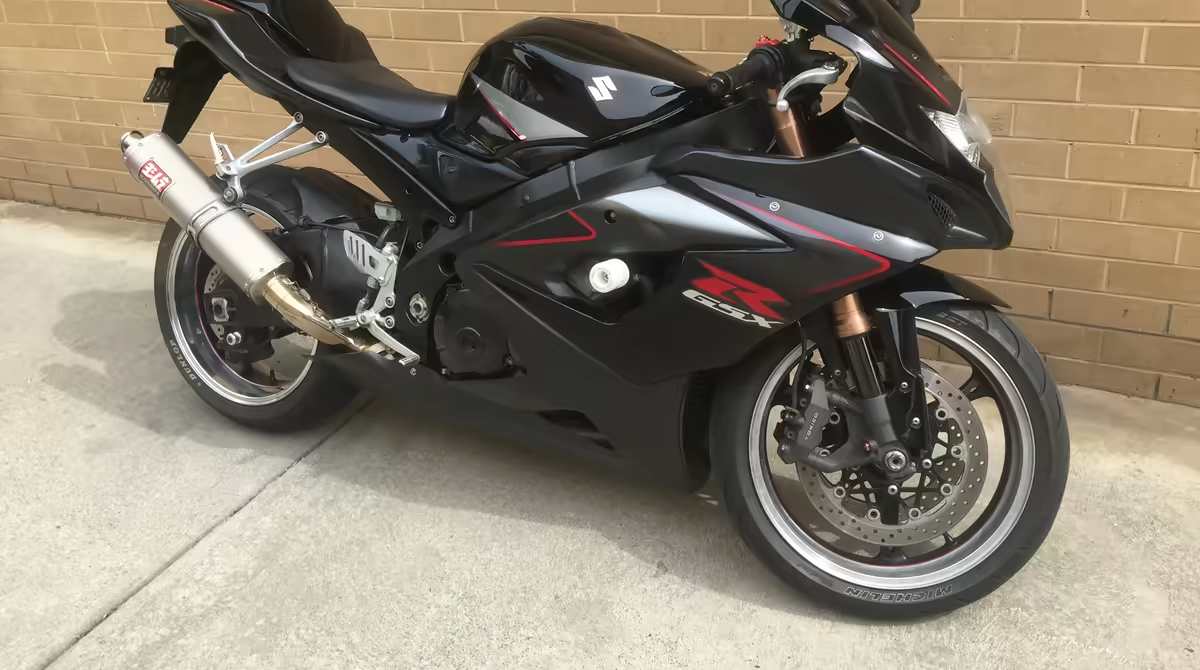
Before you pay, check:
- Does it have the EPA label with your model’s code?
- In California, does it also have a CARB Executive Order number for your motorcycle? CARB keeps a list of certified parts.
- If the listing says “for competition only” or “off-road use”, it’s not for your daily rider.
- If it brags that it “eliminates” the catalytic converter or sensors, keep walking.
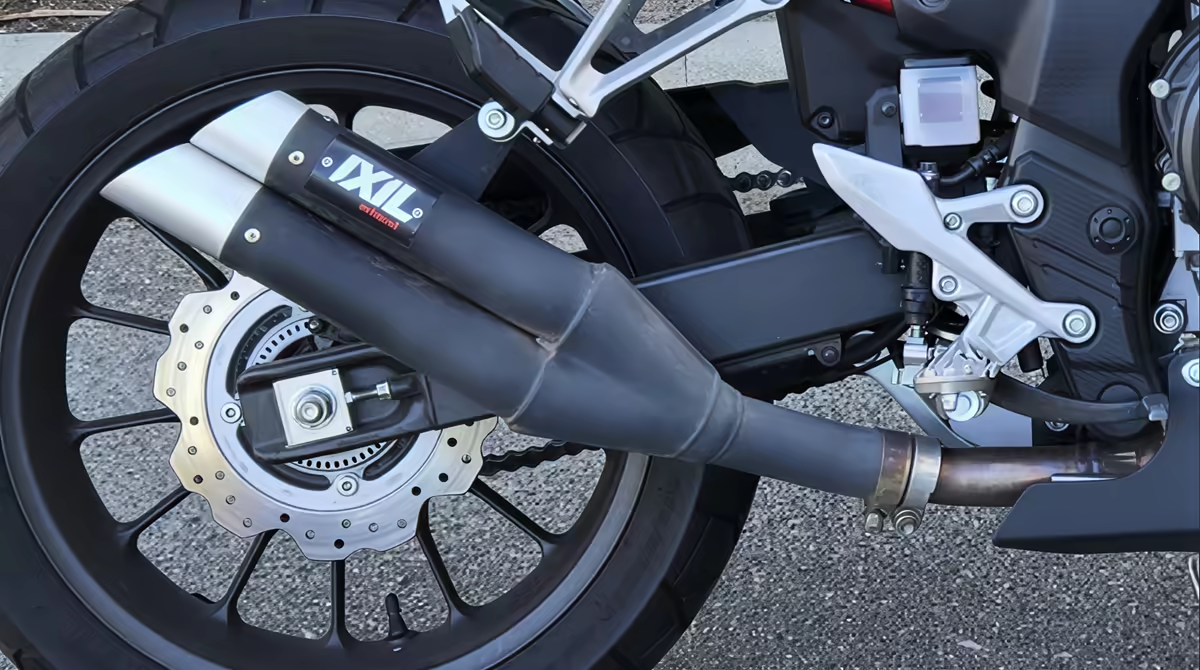
California: the label, the 80 dB limit and cameras
California reinforced the federal rule with SB 435, from 2010. According to the legislative analysis, it prohibits operating a 2013 or later model year motorcycle without the EPA noise label on the exhaust, with a fine of $50 to $100 the first time, possible dismissal if you fix the problem, and as a secondary offense: you can’t be pulled over just because an officer suspects the label is missing. State law sets 80 decibels as the cap for 1986 and later motorcycles, but the same analysis admits it’s hardly ever measured.
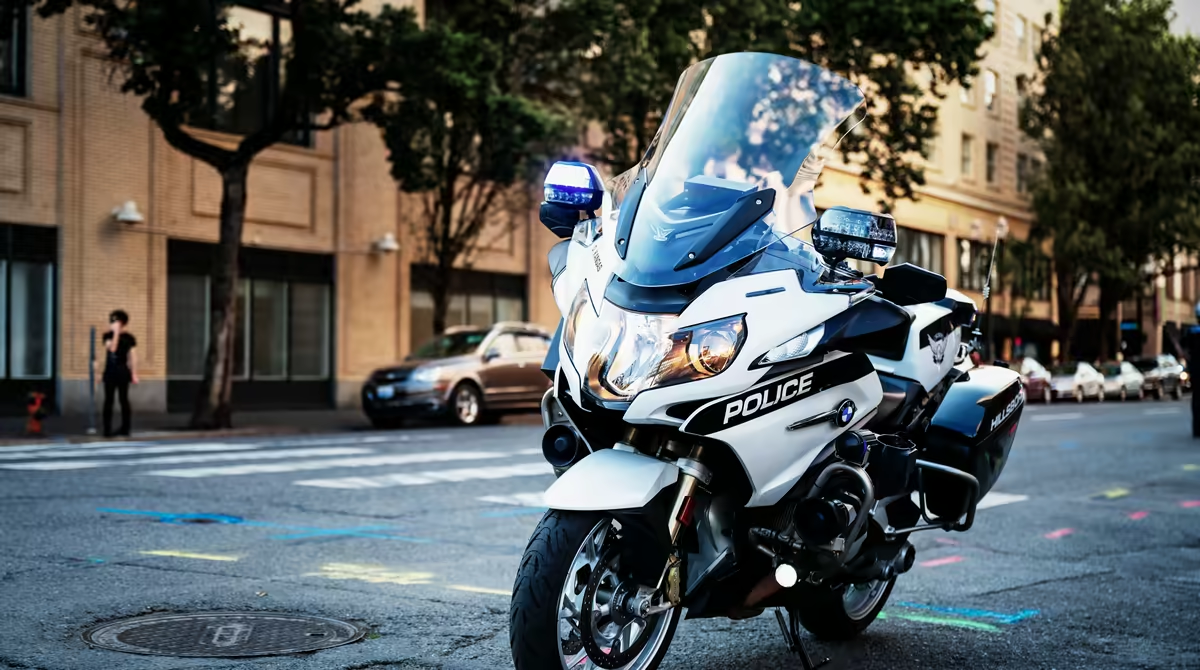
As for noise cameras, the SB 1079 bill (2022) proposed a pilot in six cities, and some reports place it between 2023 and 2027. We couldn’t confirm its current status or the thresholds, so we don’t take them as fact: if you live in California, check the bill history on the legislature’s official website.
Lane splitting and lane filtering in the U.S.
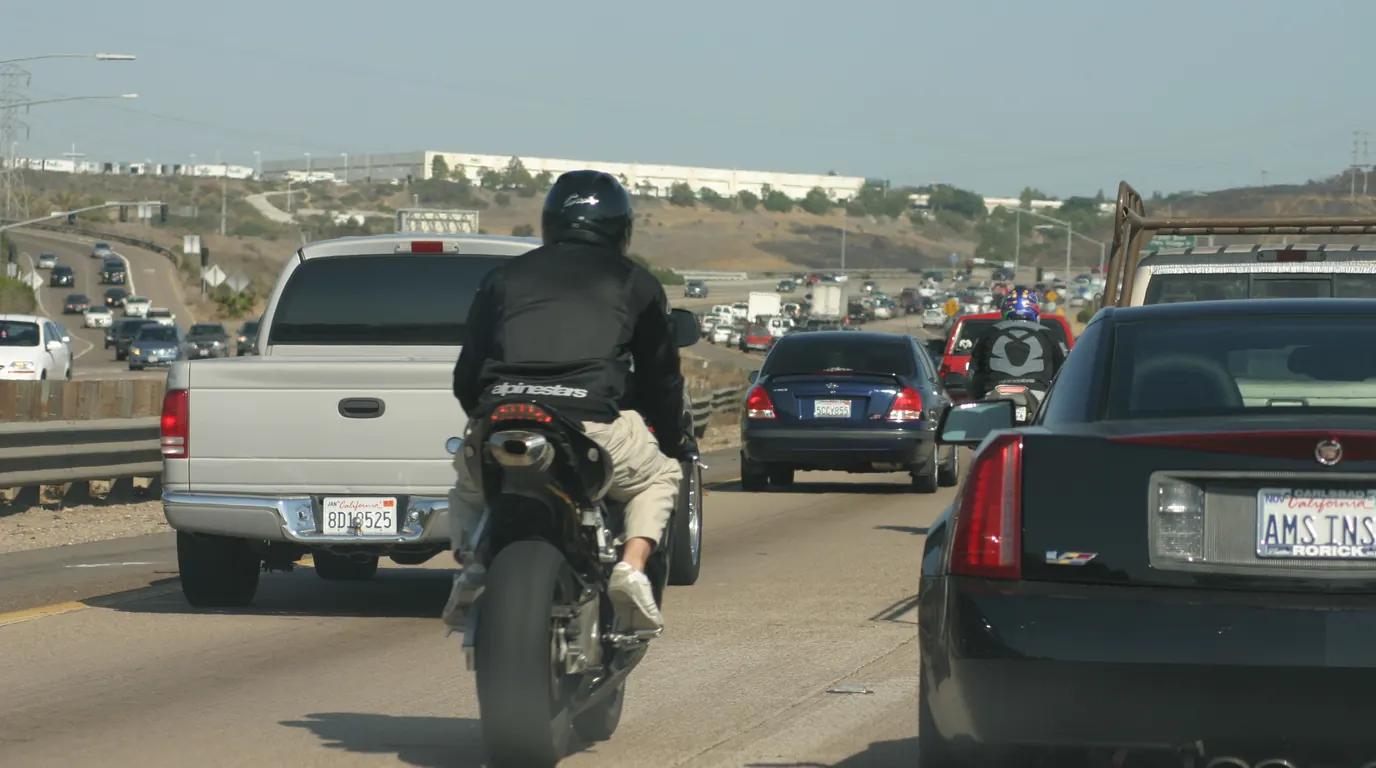
Lane splitting is riding between lanes of moving vehicles; lane filtering is moving between stopped or very slow vehicles, like at a traffic light. The general rule in the U.S. is that neither is legal; the exceptions are few and come with conditions. Status as of October 2026:
| State | What it allows | Main conditions | Law |
|---|---|---|---|
| California | Splitting and filtering | Two-wheeled motorcycle between rows of vehicles in the same lane; the law sets no speed, the CHP issues guidelines | Vehicle Code 21658.1 (AB 51), since January 1, 2017 |
| Utah | Filtering only | Road of 45 mph (72 km/h) or less, or an exit ramp; motorcycle at 15 mph (24 km/h) or less; vehicle being passed is stopped; not on entrance ramps | 41-6a-704(6) |
| Montana | Filtering only | Motorcycle at 20 mph (32 km/h) or less; vehicle being passed is stopped or at 10 mph (16 km/h) or less; wide lane | MCA 61-8-392 |
| Arizona | Filtering only | Road with two or more lanes in the same direction and a limit of 45 mph (72 km/h) or less; motorcycle at 15 mph (24 km/h) or less; vehicle being passed is stopped | A.R.S. 28-903(F) |
| Colorado | Filtering only | Stopped traffic; motorcycle at 15 mph (24 km/h) or less; on the left, without entering the opposing lane; since August 7, 2024 | SB24-079 |
| Minnesota | Passing in the same lane | At 25 mph (40 km/h) or less and no more than 15 mph (24 km/h) faster than traffic; excludes roundabouts, school zones, single-lane work zones and ramps with a line of cars | 169.974, subd. 5 |
Notes:
- California is the only state where lane splitting with moving traffic is written into law. The law tells the CHP to issue guidelines, and its motorcyclist safety page advises, for example, not to do it next to large vehicles or on the shoulder, which is illegal.
- Utah: according to a 2026 review by the state legislature and local press, the law expires on July 1, 2027 unless it’s extended. Confirm it’s still in force.
- Minnesota doesn’t say “filtering”, but it allows passing within the same lane under those caps; other maneuvers between lanes are still prohibited.
- Texas expressly prohibits it since 2023; we give you the details below.
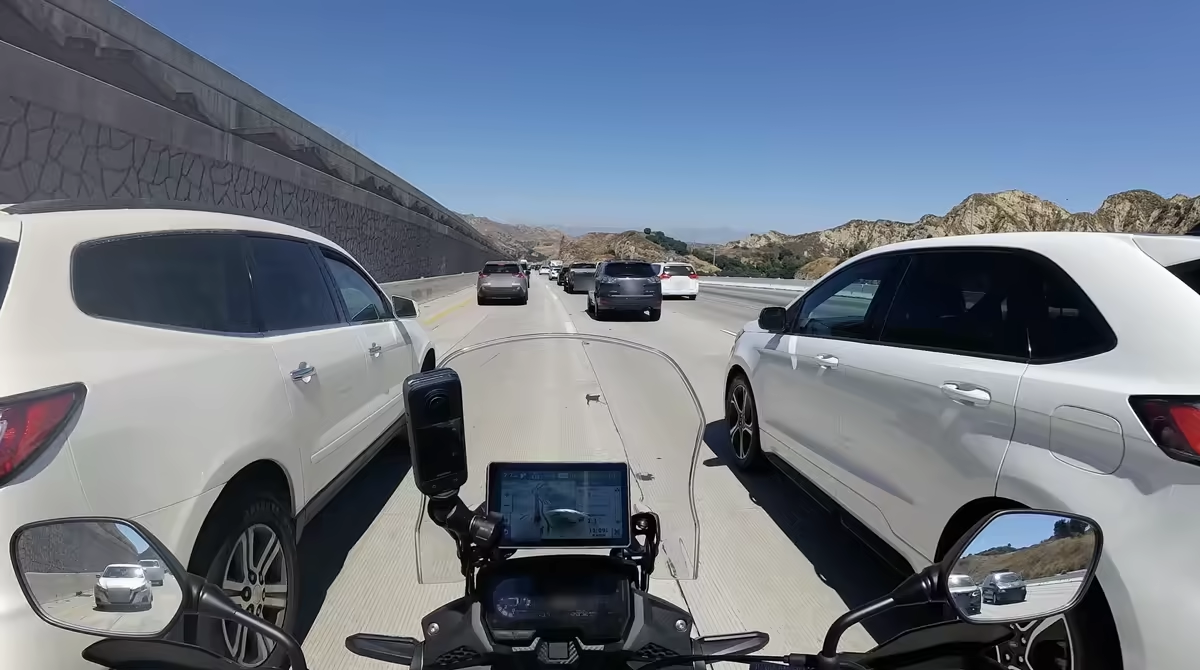
Outside these six states, from what we checked, riding between lanes is illegal; legislatures change laws every year, so check each state before a long trip (in our first highway trip guide we cover the practical side of the road). And legal isn’t the same as safe: filtering takes low speed and close attention to doors and lane changes.
Texas motorcycle laws: what we know
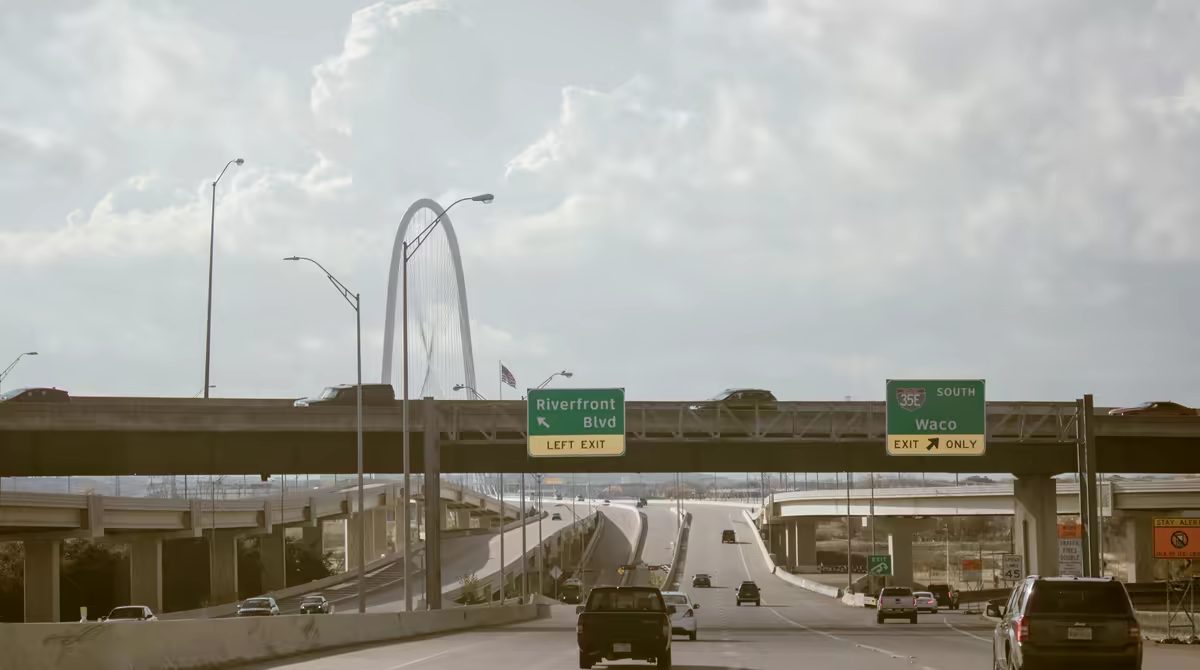
For my friends who ask about the rules in Texas, well, here’s what we know. We checked it in November 2026 in the text of the Texas Transportation Code and on the websites of the DPS (Department of Public Safety), the TxDMV (Department of Motor Vehicles) and the TCEQ (Commission on Environmental Quality). If you’re thinking of living there, this is the first thing worth knowing.
| Topic | What Texas law says | Source |
|---|---|---|
| Lane splitting and filtering | Prohibited since September 1, 2023; two motorcycles may ride side by side in one lane | Transportation Code 545.0605 |
| Helmet | Required; riders 21 and older are exempt if they completed an approved course or have health insurance that covers motorcycle injuries | 661.003 |
| Passenger | Motorcycle designed for two, with footrests and handholds; passenger 5 or older | 545.416 |
| Exhaust | Muffler in good working condition, no cutouts or bypasses; state law sets no decibel limit | 547.604 |
| Emissions | Don’t remove or disable the system; motorcycles aren’t emissions tested | 547.605 and TCEQ |
| Inspection | No safety inspection since 2025; $7.50 annual fee at registration | 548.510 |
| Minimum insurance | $30,000 / $60,000 / $25,000 | 601.072 |
| If you move there | Register within 30 days; drive on your previous license for up to 90 days | 502.040 and 521.029 |
Is lane splitting legal in Texas?
No. Since September 1, 2023, section 545.0605 of the Transportation Code, added by HB 4122, spells it out: a motorcyclist is entitled to the full use of a lane and no car may take it away; two motorcycles may ride side by side in the same lane, but no more than two, and riding between lanes of traffic moving in the same direction and passing a vehicle within its own lane are prohibited. The law doesn’t distinguish between fast and stopped traffic, so in Texas there’s no legal filtering at a red light either. Only police officers on duty are exempt.
Texas motorcycle helmet law and passengers
A helmet is required for the rider and the passenger, with one exception: being at least 21 and having completed a state-approved motorcycle training course, or having health insurance that covers injuries from a motorcycle crash (section 661.003). Police can’t stop you just to check whether you meet the exception, though they can stop you to check that your helmet meets the standard, and the fine for not wearing one is $10 to $50. A $10,000 medical coverage figure still circulates online; it doesn’t appear in the current text we read. Even if the law exempts you, ride with a helmet: in our guide to DOT, ECE, Snell and NOM certifications we explain how to choose one.
To carry a passenger, the motorcycle must be designed for two people and have footrests and handholds for whoever rides behind. The passenger must be at least 5 years old, unless they ride in a sidecar, and the fine for carrying a child under that age is $100 to $200 (section 545.416).
Motorcycle exhaust, emissions and inspection in Texas
Texas law doesn’t set a decibel limit for motorcycles. What section 547.604 requires is a muffler in good working condition that continually operates to prevent “excessive or unusual noise”, and it prohibits muffler cutouts, bypasses and similar devices. With no number involved, what counts as “excessive” is up to whoever pulls you over. The federal EPA label rule we covered above applies in Texas too.
Emissions work in a similar way. Section 547.605 requires keeping the emissions control system of vehicles from model years after 1967 in good working condition and prohibits removing it or intentionally making it inoperable, unless you’re installing another one that’s equally effective. Emitting visible smoke for 10 seconds or more is also an offense. The fine is $1 to $350 per violation, and $200 to $1,000 for repeat offenders.
What there isn’t is emissions testing for motorcycles. The TCEQ requires it in 18 counties (those in the Houston, Dallas–Fort Worth and Austin areas, El Paso and, since November 1, 2026, Bexar, home to San Antonio), but it expressly excludes motorcycles. And since January 1, 2025, under HB 3297, non-commercial vehicles no longer get a safety inspection, according to the DPS. In exchange, when you register or renew you pay a $7.50 annual “inspection program replacement fee” (section 548.510).
Moving to Texas with a motorcycle: registration, license and insurance
- Registration: you have 30 days after becoming a resident to register your motorcycle with your county tax assessor-collector’s office (section 502.040). The TxDMV explains it step by step in its guide for new residents.
- License: you can drive on the license from your previous state or country for up to 90 days after arriving (section 521.029). To get a Class M (motorcycle) license for the first time, Texas requires an approved training course, but that doesn’t apply if you already hold a valid license from another state with motorcycle authorization (section 521.148). According to the DPS, if you’re an adult transferring a valid, unrestricted Class M license from another state or from Canada, you may be exempt from the skills test. If you’re coming from Mexico or another country, check our motorcycle license guide for foreigners.
- Insurance: the minimum is $30,000 per injured person, $60,000 per crash and $25,000 for property damage (section 601.072).
Mexico: rules for motorcyclists in Mexico City
We cite the consolidated version of the Mexico City Traffic Regulations on the PAOT website, last amended in April 2019. There was another amendment in August 2023 that, according to the city’s Official Gazette, changed articles 37 and 44 among others, so compare it against the current text.
- Article 20: in addition to the general traffic rules, motorcyclists must use a full lane, pass only on the left and follow the right-of-way rules.
- Article 21, section IV: prohibits riding between lanes, except when traffic is stopped, to reach the motorcycle waiting area or a visible spot to start moving again, without blocking crosswalks. There’s no lane splitting in Mexico City.
- Article 21, other sections: prohibits riding on sidewalks and pedestrian areas, bike-only lanes and lanes reserved for public transit; using the center lanes of controlled-access roads on motorcycles under 250 cc; riding where signs restrict it, and reckless maneuvers. You can get your bike impounded and a fine.
- Article 37, section III: front and rear lights always on, only as many people as there are seats, and a helmet “designed specifically for motorcyclists”, fastened, for the passenger too. Jacket, gloves and boots are listed as recommended. To choose a helmet, see our guide to DOT, ECE, Snell and NOM certifications.
- Article 44: a valid license of the right type (or a permit, if you’re a minor). If you’re coming from another country, check how motorcycle licenses work in Mexico and other countries.
Fines change every year with the UMA, Mexico’s unit of measure for fines; that’s why we don’t give amounts. Check them with the Ministry of Mobility.
Frequently asked questions
Is it legal to change my motorcycle’s exhaust in the U.S.?
Yes, if the replacement has the EPA noise label for your model and, in California, CARB certification too. What’s illegal is tampering with emissions controls or installing an unlabeled exhaust that exceeds the limit.
What does it mean for a motorcycle to be a “California model”?
That it has a CARB Executive Order for that make, model and year, which is why it can be sold new in California. A “49-state” model only meets the federal rule.
Can I lane split in any state if I’m careful?
No. It’s legal in California; Utah, Montana, Arizona, Colorado and Minnesota allow variants with speed limits. Everywhere else, from what we checked, it’s prohibited; in Texas, expressly since 2023.
Can I filter between cars at a red light in Texas?
No. Since September 2023, Texas law prohibits riding between lanes and passing within the same lane, with no exception for stopped traffic. The only thing allowed is two motorcycles riding side by side in one lane.
Is a motorcycle helmet required in Texas?
Yes, unless you’re 21 or older and have completed an approved course or have health insurance that covers motorcycle injuries. The fine is $10 to $50.
Do motorcycles need an inspection or emissions test in Texas?
No. Since 2025, non-commercial vehicles don’t get a safety inspection, and emissions testing excludes motorcycles even in the counties where it applies. When you register, you pay a $7.50 annual fee.
Are motorcycles emissions tested in Mexico City?
Not from what we checked as of October 2026: the program exempted them in the second half of 2025. There’s a bill to include them, with no official confirmation.
Is Mexico’s new emissions standard for motorcycles mandatory yet?
No. PROY-NOM-175-SEMARNAT-2026 was published as a draft in April 2026 and isn’t binding until the final version comes out.
What to do with all this
Some laws protect everyone’s air and ears; others protect your skin in traffic. The simplest way to stay on the right side is to check the label before you buy a part, ask which version your motorcycle is before you pay for it and read each state’s official text before you cross into it. If something changed after October 2026, send us the official text. Ride safe.
Photos
Cover: Eric Schmuttenmaer, via Wikimedia Commons · CC BY-SA 2.0 · cropped.
Photo 1: Michael KR, via Wikimedia Commons · Public domain.
Photo 2: Robertedwardkroll, via Wikimedia Commons · CC0.
Photo 3: Michelle Toma, via Pexels · Pexels License.
Photo 4: Ernos5, via Wikimedia Commons · CC BY-SA 4.0 · cropped.
Photo 5: the author’s personal archive.
Photo 6: Brett Sayles, via Pexels · Pexels License.
Photo 7: the author’s personal archive.
Photo 8: Mizzu Cho, via Pexels · Pexels License.


