Honda Gold Wing history: generations and used buying guide
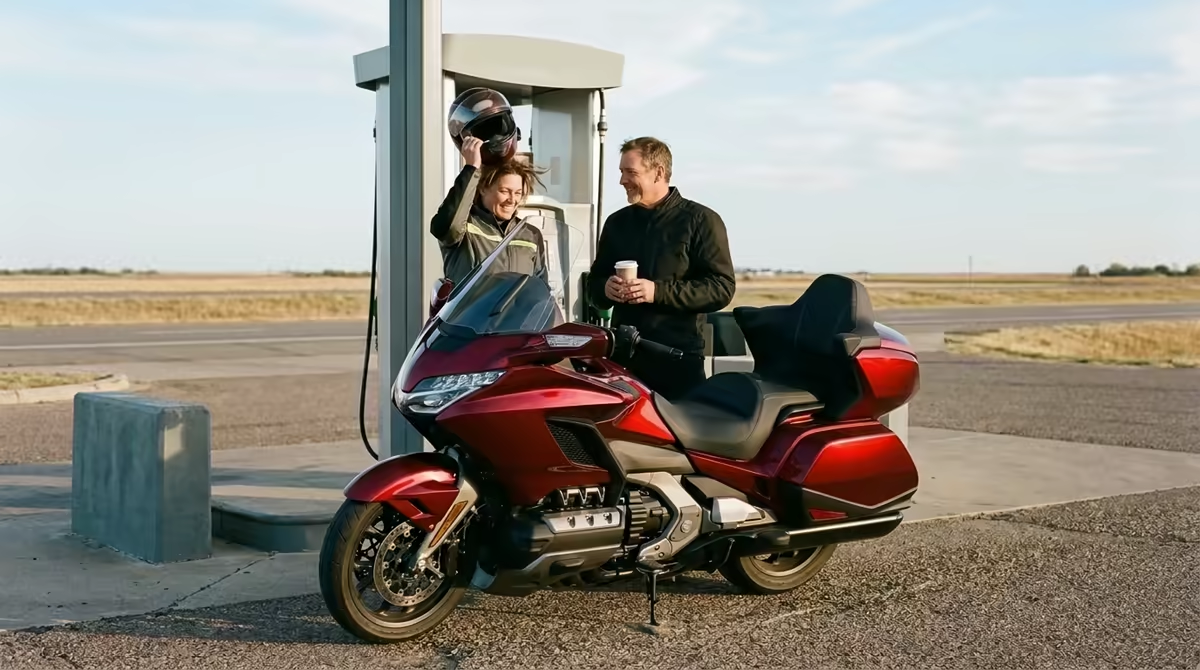
You’re at a gas station in Texas, halfway through a thousand-mile trip, and a Honda Gold Wing pulls in with a couple on board, the luggage full and the engine so quiet you barely notice it. Nobody gets off worn out. She takes off her helmet, he orders a coffee, and you’re left wondering how much a bike like that costs and whether it’s really worth it. That’s when you realize that big motorcycle could be a great addition to your long-distance trips: you picture a road trip with no back pain, no sore rear end, with all the comfort of traveling on “a living-room couch” with an engine and wheels.
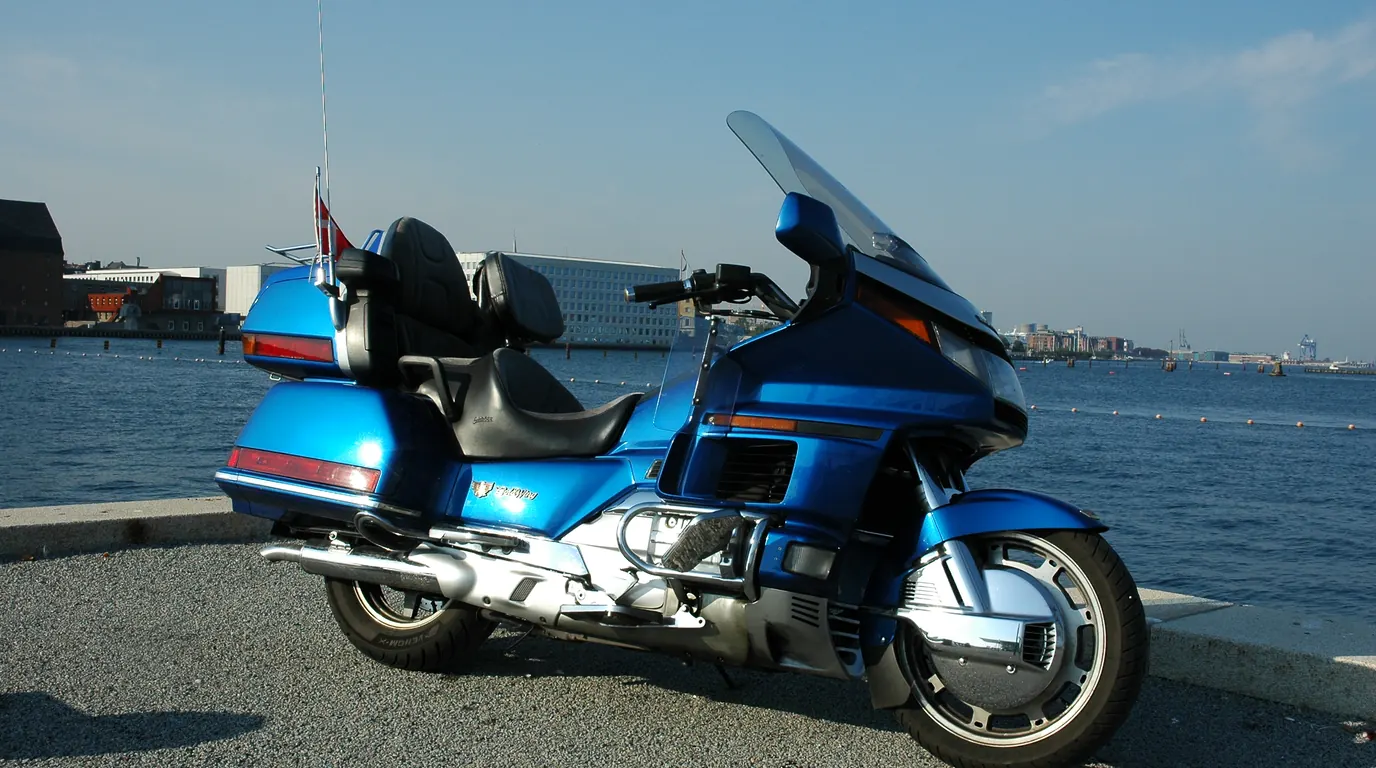
That’s how almost all of us react the first time we see one on the road. The Gold Wing isn’t the fastest bike or the lightest, but the history it carries speaks for itself: half a century as the yardstick for luxury touring on two wheels. In this post we go through how it evolved generation by generation, why its engine has so many fans and what to look for if you’re thinking about buying a used one, because I’ve thought about it too, and that’s why I decided to write this article.
In short: The Gold Wing was born in 1975 with a four-cylinder boxer engine and today runs a horizontally opposed six · Its history has five big changes (1980, 1984, 1988, 2001 and 2018) · It was the first production motorcycle with an airbag, according to Honda · If you buy used, the maintenance history matters more than the mileage · It’s a bike for riding long and comfortable, not for maneuvering in the city
Where it came from: the 1975 Honda GL1000 Gold Wing
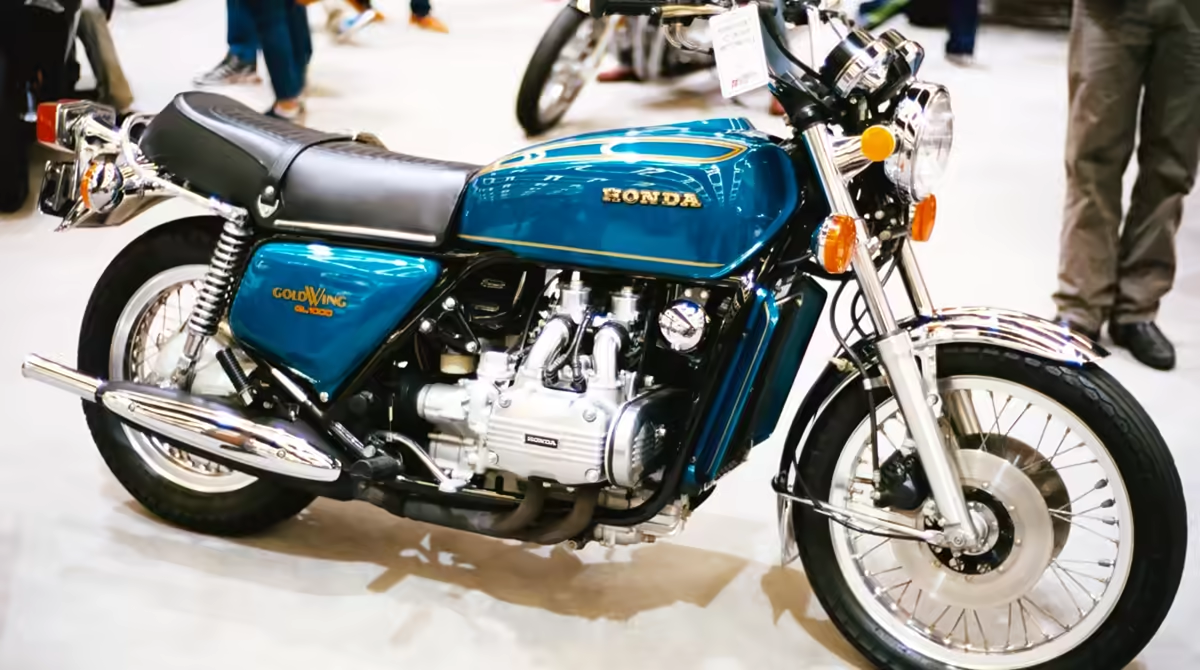
Let’s get to the history: Honda unveiled the first Gold Wing in September 1974 at a dealer meeting in the U.S., and it went on sale in 1975. It was also shown in Cologne and Paris that same year, according to Honda’s own timeline. The idea was a high-speed, long-distance motorcycle built mainly for the American market.
What made it odd, or different, was the engine: a four-stroke four-cylinder of about 1,000 cc, with horizontally opposed cylinders, liquid cooling and shaft drive instead of a chain. Honda describes it as the only engine of its kind in a motorcycle of its time. Many people call that layout a “boxer” because of the way the pistons move, and that, my friends, is the seed of everything that came after.
The GL1000 came out as a naked bike, without the fairing or the luggage that define it today. Luxury touring came later, with the generations that followed.
Gold Wing generations, one by one
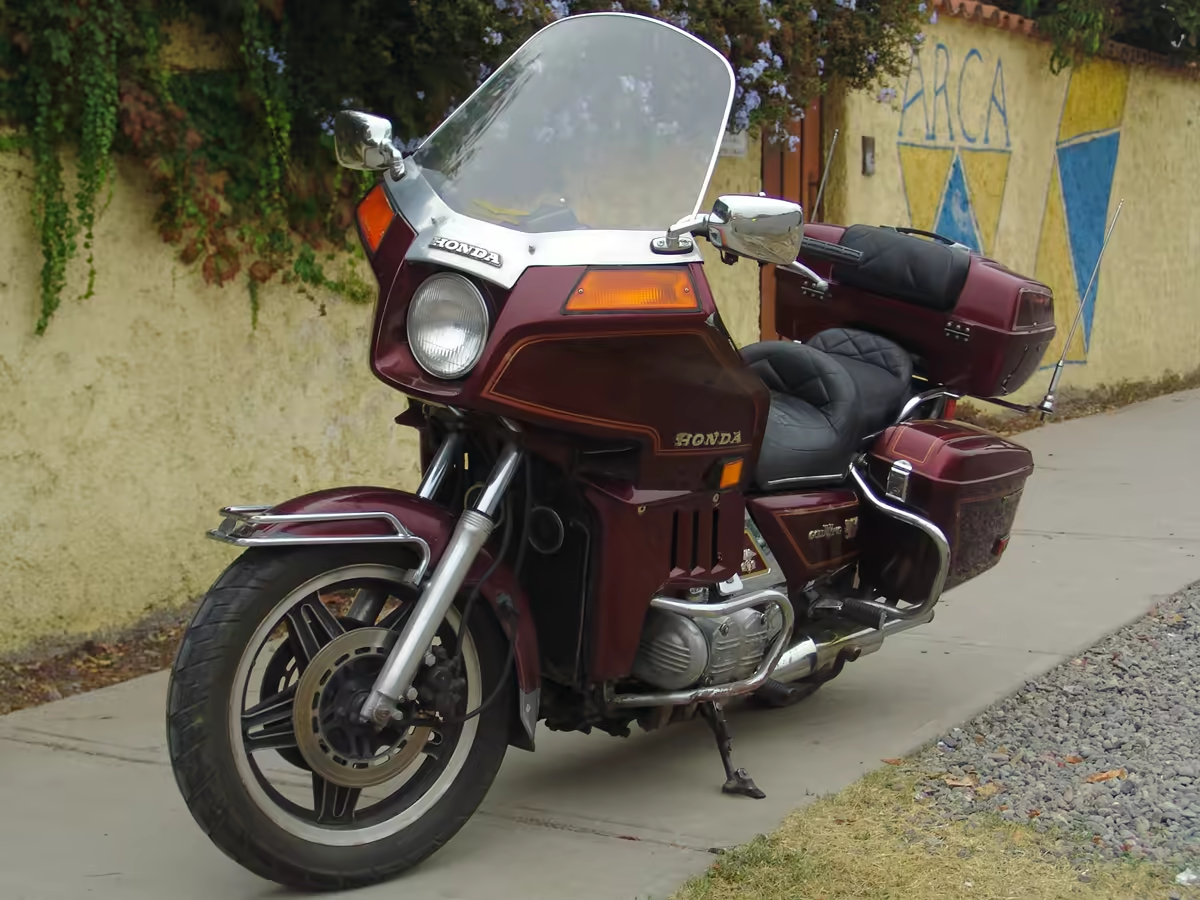
GL1100 (1980): a factory fairing at last
The second generation arrived in 1980 with a 1,085 cc engine, electronic ignition, more fuel capacity and less weight, according to Rider. The Interstate version brought a factory fairing and luggage, plus an optional stereo and intercom. This is where the Wing stopped being a big sport bike and became a touring bike.
GL1200 (1984): more displacement, more stability
The third generation grew to 1,182 cc and got a stiffer frame, smaller wheels, a longer wheelbase and improved suspension. It already had the spirit we know: comfortable, stable and built for two.
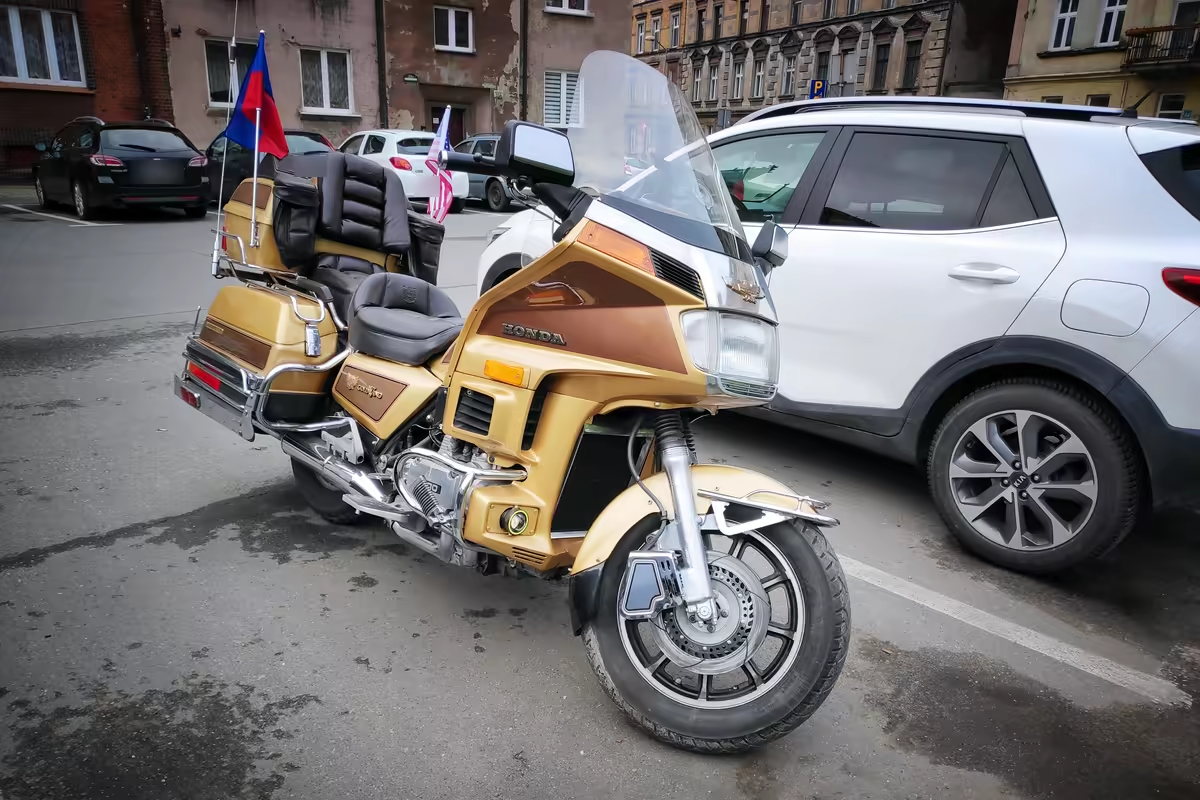
GL1500 (1988): the jump to six cylinders
The biggest change came in 1988: a 1,520 cc six-cylinder boxer, more power, a stiffer frame, better brakes and full bodywork. Honda marks it as the first six-cylinder in the series.
This generation also introduced reverse. Several sources explain that it isn’t a gear in the gearbox but an electric function that uses the starter motor to move the bike backward at low speed. It’s a parking aid, and anyone who has pushed a heavy bike uphill knows what it’s worth.
GL1800 (2001): aluminum and fuel injection
The fifth generation debuted a 1,832 cc six-cylinder with electronic fuel injection and an aluminum frame, with optional ABS. With updates, it stayed in production through 2017.
The Gold Wing airbag (2006)
In September 2005 Honda announced what it called “the world’s first production motorcycle airbag system,” which would reach the Gold Wing in the U.S. in late spring 2006. Four sensors on the fork measure sudden changes in acceleration in a frontal crash, a computer decides whether to deploy, and an inflator fills the bag with nitrogen. Honda says only 0.060 seconds pass between detecting the impact and full inflation.
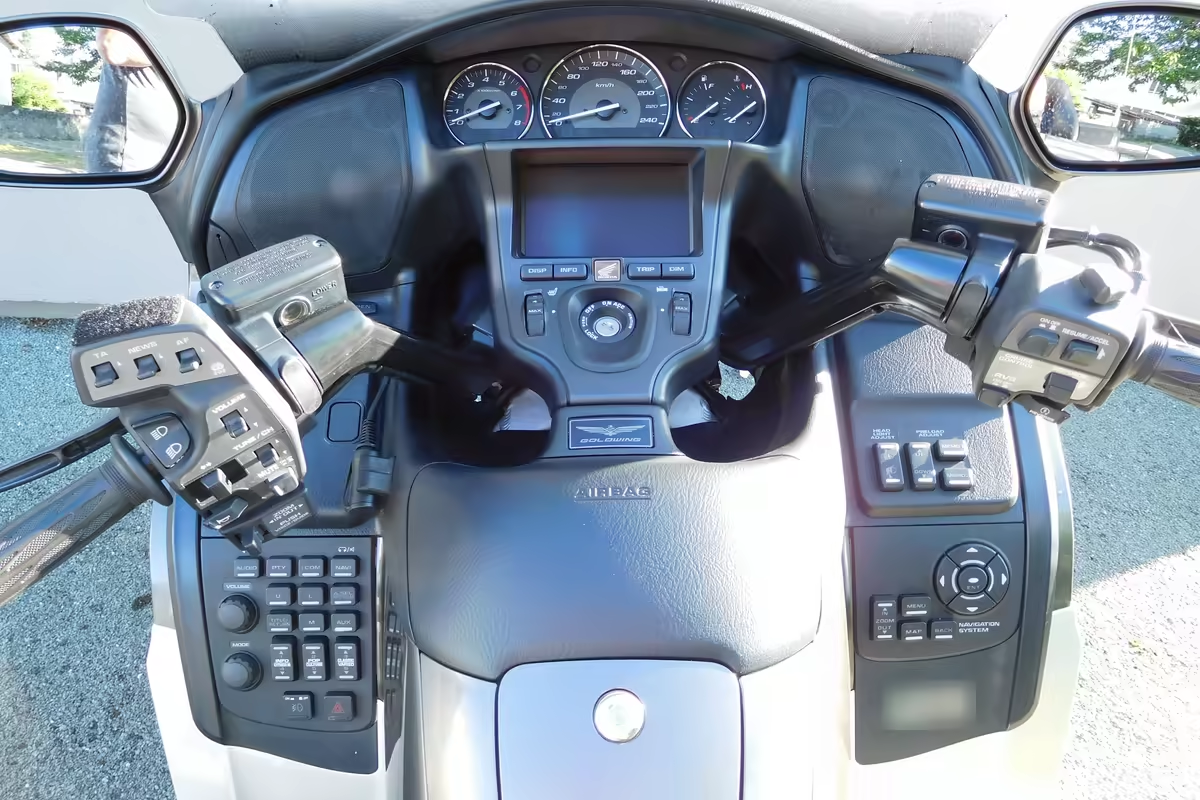
Two useful clarifications. First, that’s Honda’s claim; other sources repeat it, but it’s worth citing for what it is. Second, it was optional equipment, not standard.
GL1800 (2018): the complete redesign
The sixth generation was unveiled in October 2017 as a 2018 model, with deep changes:
- A six-cylinder boxer engine of about 1,833 cc according to the motorcycle press, lighter than the previous one (Honda talks about 13.7 pounds less with the six-speed manual gearbox).
- Double-wishbone front suspension, a Honda design, instead of the traditional telescopic fork.
- An optional seven-speed dual-clutch automatic transmission (DCT), with a “Walking” mode that lets you move forward and backward at walking pace.
- A 7-inch TFT screen and, according to Honda, Apple CarPlay as an industry first.
- Torque control, hill start assist and four riding modes (Tour, Sport, Econ and Rain).
The Gold Wing’s 50th anniversary (2025)
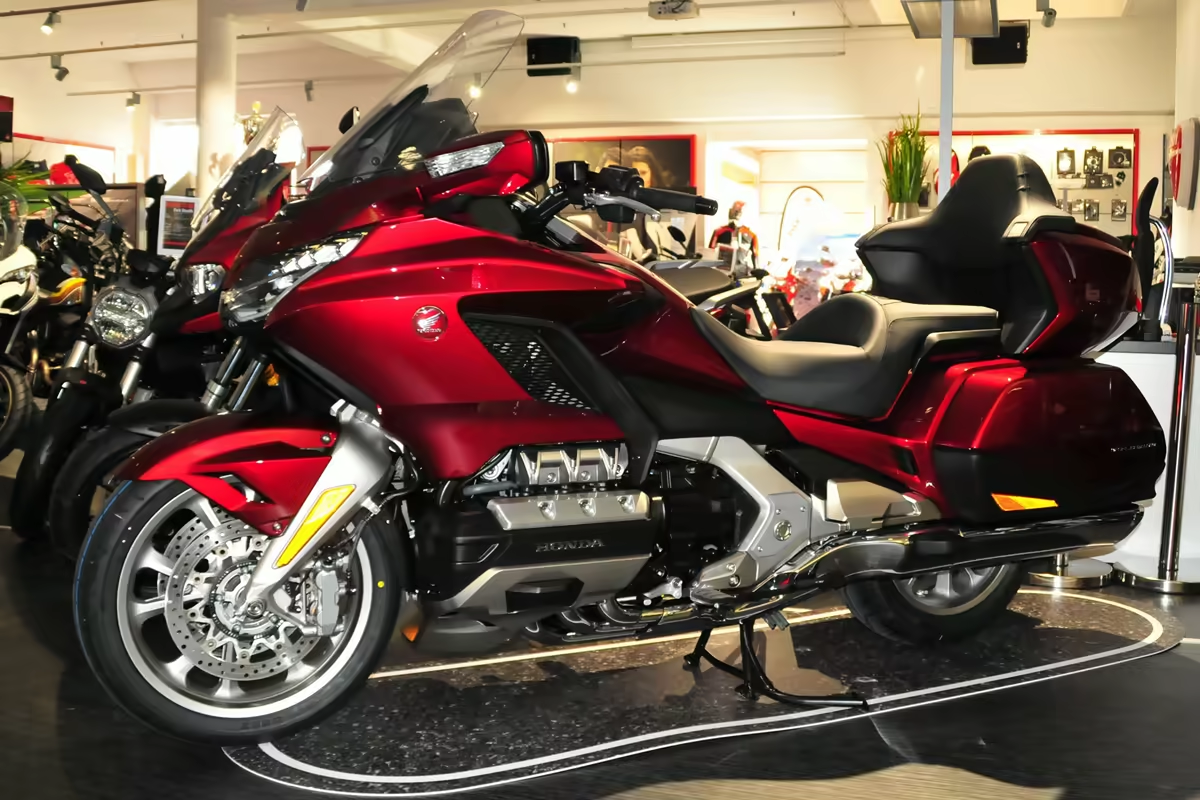
Honda marked 2025 as fifty years of Gold Wing sales. It presented an anniversary edition with special colors and badges and, according to the press, added wireless CarPlay and Android Auto. The changes were mostly cosmetic, not mechanical. If you want price figures, check them on Honda’s website: in early 2025 the talk was of a starting list price around $25,000.
Where the Gold Wing is made: from Ohio to Japan
The first units came out of Honda’s plants in Saitama, Japan, in late 1974. In 1980 Honda started building the Gold Wing in Marysville, Ohio, at a plant it had opened in 1979. It was a bet on building the bike in its main market.
According to Honda’s timeline, production in Marysville ended in 2009. There was a gap: Rider notes that no Gold Wing was built in 2011 while the line moved, and Honda places the start at the Kumamoto factory in Japan that same year, 2011. Some sources give 2010 as Ohio’s last year, so if you’re buying a unit from those years, confirm where it was assembled on the VIN plate or with a dealer.
Why the Gold Wing’s boxer engine is so loved
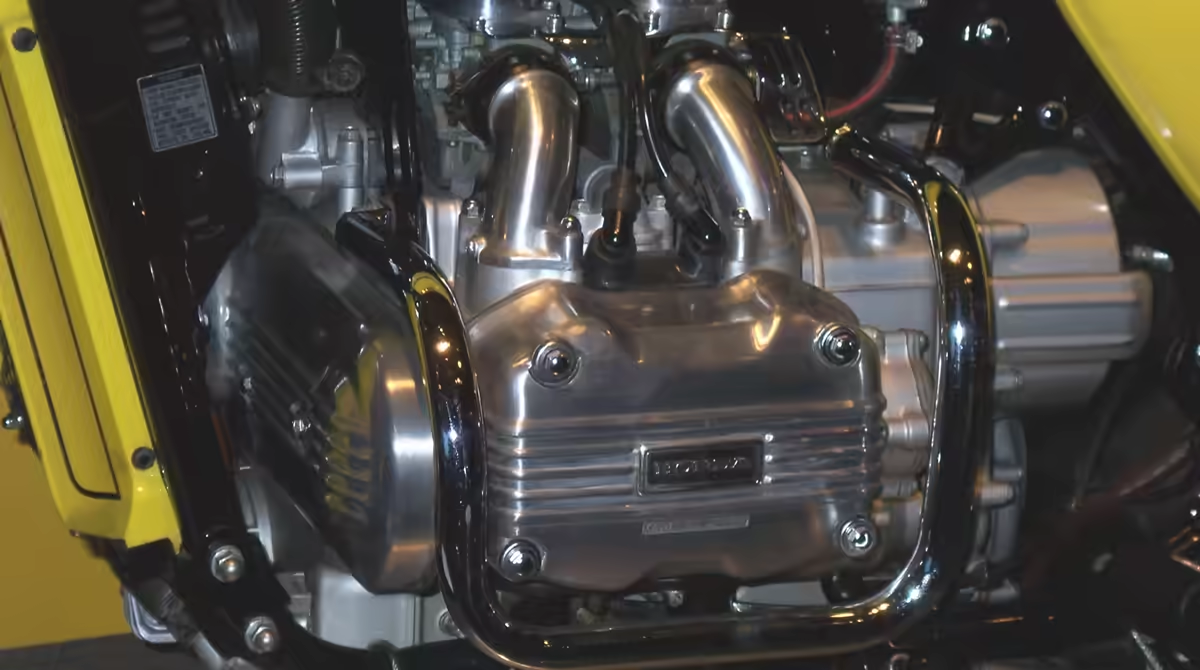
The reason comes down to physics. In a boxer engine the cylinders lie flat on each side and the pistons move in opposite directions, like two boxers touching gloves. A good share of the vibrations cancel each other out, and that’s where the smoothness many people describe as “silky” comes from.
There’s a second advantage: a low center of gravity. Because it lies flat, the engine sits close to the ground and the bike feels more stable than its weight suggests. At low speed it takes more effort, but once you’re rolling on the highway, you’re grateful for it.
Add that it’s a liquid-cooled engine, with shaft drive instead of a chain, and a reputation among owners for lasting a long time. That reputation comes from testimonials, not from an official statistic, so take it as a reference.
The culture around the engine: trikes and projects
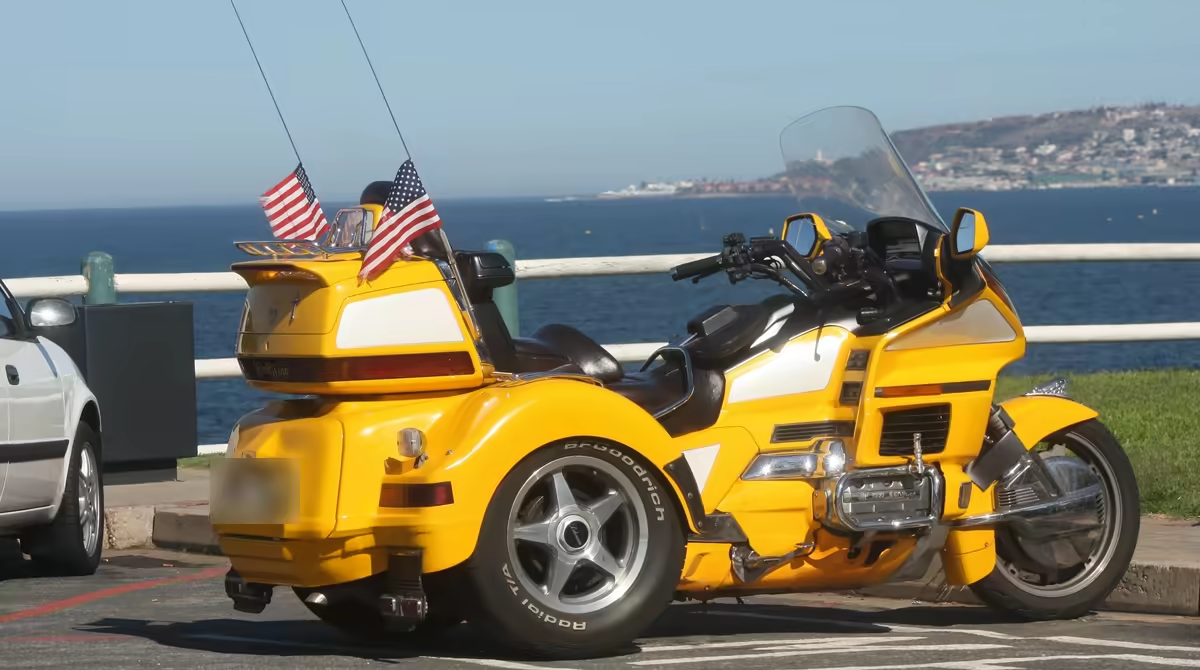
All that affection has a curious effect: there are hobby mechanics who adapt Gold Wing engines to other vehicles. The best documented are trikes, that is, three-wheeled motorcycles: manufacturers such as Lehman Trikes built production models on a Gold Wing base, with its six-cylinder engine and shaft drive. Forums and hobby shops also share projects that put these engines into small rear-engine cars. Here we stay general: we didn’t verify individual cases, and an engine swap involves engineering, registration and insurance that vary by state and country.
There’s one case that is documented, though: the creator of the YouTube channel JT Built It put the 1.5-liter flat-six from a 1988 Gold Wing, that is, a GL1500, into a 1974 Volkswagen Super Beetle, the car Mexico calls the “Vocho.” He used the Gold Wing’s own radiators, its five-speed gearbox and the differential from a Polaris RZR, and the car ended up with no reverse. And he didn’t stop there: he announced that his next project is a Porsche 914/4, with quite a bit of rust, which will also get a Gold Wing engine.
The lesson is simple: an engine this compact, smooth and easy to find is tempting for people who build things.
Buying a used Gold Wing: a guide
As with any vehicle, it’s worth going through the following steps, and the general rule applies to every generation: a good maintenance history is worth more than low mileage. A Gold Wing that sat for ten years can be in worse shape than one with 100,000 well-kept miles.
What to check on any used Gold Wing
- Service records. Ask for receipts for oil, coolant, brake fluid and final drive. Without paperwork, negotiate as if everything were overdue.
- Battery and electrical system. These bikes carry a lot of equipment (lights, audio, heating, accessories). Measure the voltage with the engine off and running; weak charging can point to the battery or the charging system. Owner forums talk about stator and regulator wear on older models, but that’s enthusiast information, not an official bulletin. Treat it as a reason to check, not as a proven defect.
- Timing. It depends on the generation (see below). Ask when it was last done.
- Brakes, tires and suspension. Old tires, even if the tread looks good. Check the shocks for leaks and the steering for play.
- Reverse and electrical features. Test reverse where it exists, the audio, cruise control and the heated grips and seat.
- Open recalls. Look up the VIN on NHTSA’s recalls page. There have been recalls on the GL1800 in several periods, including airbag inflators on 2006 to 2010 models and a dragging rear brake on 2001 to 2015 versions, according to NHTSA records cited by the press. Confirm for yourself what applies to your VIN.
GL1000, GL1100 and GL1200 (1975 to 1987)
They’re classics: they’re worth more to collectors than for daily use. Buy with a restorer’s eye: engine condition, parts history and parts availability. In this era, timing and other adjustments depend on the year; check the service manual for the specific model, because we didn’t verify every detail by year here.
GL1500 (1988 to 2000)
The cheapest of the modern ones, with a six-cylinder engine. It uses timing belts, not chains. Specialist sources cite a change every 100,000 miles or 10 years as a reference; confirm with Honda’s service manual for your year, and if there’s no proof it was done, take the cost of the job off the price. Also check that reverse works.
First-era GL1800 (2001 to 2017)
More powerful and more modern, with fuel injection and an aluminum frame. Unlike the GL1500, it uses timing chains, not belts. For many buyers it’s the best balance of price and capability. Check the recalls mentioned above and, if it has an airbag, make sure the dashboard warning light goes off without a fault.
Sixth-generation GL1800 (2018 and later)
Lighter, with modern electronics, optional DCT and CarPlay. It’s also the most expensive. Before buying, check NHTSA for the fuel pump and primary drive bolt recalls, which according to NHTSA have affected some 2018 to 2021 units, and ask whether they were done. If you’re buying a DCT, ask for a long test ride in traffic to see if it suits you.
Who the Gold Wing is for, and who it isn’t for
It’s for you if:
- You take long trips of several days, solo or two-up, and you value comfort over speed. If that’s your thing, read our guide to the long solo motorcycle road trip.
- You carry luggage and want space, wind protection and a good audio system.
- You prefer predictable maintenance and a bike that feels stable on the highway. Before your first long ride, go over how to handle your first highway trip.
It’s not for you if:
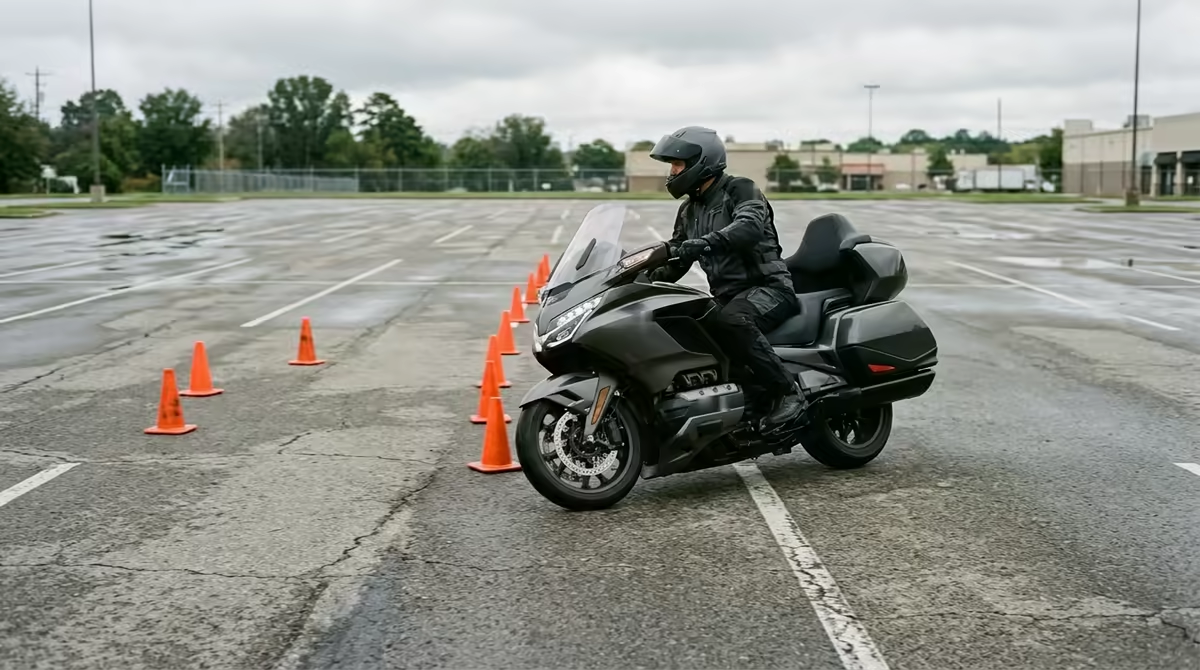
- You’re a beginner. It’s a heavy bike, and low-speed maneuvers demand technique. Start with getting started on a motorcycle and a lighter bike; take a look at our best beginner motorcycles.
- You live in a city with heavy traffic, narrow streets or tight parking.
- You want a sport bike or a dirt bike. The Wing isn’t built for that.
And always, no matter how comfortable it is: a certified helmet, jacket, gloves, pants and boots. Weight and speed don’t forgive.
Frequently asked questions
When did the first Honda Gold Wing come out?
Honda unveiled it in September 1974, and it went on sale in the U.S. in 1975 as the GL1000. It’s the model that started the saga.
Was the Gold Wing the first motorcycle with an airbag?
Honda presented it in 2005 as the first airbag system for a production motorcycle, and it reached the Gold Wing with a U.S. launch date in late spring 2006. It was optional. The claim is Honda’s, and other sources repeat it.
Where is the Gold Wing made today?
At the Kumamoto factory in Japan, where it has been built since 2011. Before that, between 1980 and 2009 according to Honda, it was assembled in Marysville, Ohio.
Which used Gold Wing is the best buy?
It depends on your budget. The 2001 to 2017 GL1800 is usually a good middle ground, with timing chains instead of belts. The 2018 and later bike is more modern but more expensive. In every case, the maintenance history matters more than the year.
How often should you change the timing belts on a GL1500?
Specialist sources cite 100,000 miles (about 160,000 km) or 10 years as a reference. It isn’t a figure we took from the manual: confirm it in Honda’s service manual for your year.
How much does a new Honda Gold Wing cost?
In early 2025 the talk was of a starting list price around $25,000 in the U.S. It changes with the version and the year, so confirm the figure on Honda’s website before you do the math.
Wrapping up
The first time I saw a couple get off a Gold Wing, my mind went on the trip with them: its big console, its living-room couch, its wind protection, the audio system (well, not so much that one, but it still counts). And going through the history of that bike, I noticed it has survived half a century of trends for the simple reason that it never tried to be anything else: a bike for covering a lot of road calmly, without wearing you out, and enjoying every mile, every kilometer. Each generation kept adding comfort, safety or technology without losing the boxer’s character. If you’re curious like me and a used one tempts you, it’s time to do your homework: a test ride if possible, and then service records, recalls by VIN and a budget for whatever’s missing. And if you don’t have the technique to move it and master it yet, take your time, practice constantly, check your technique. The road will still be there.
Further reading: Honda’s official timeline, 50 years of the Gold Wing · the 2018 Gold Wing announcement on Honda News · Honda’s 2005 airbag press release · Rider Magazine: 50 years of the Gold Wing
Photos
Cover: Knak (fotokongen.dk), via Wikimedia Commons · CC BY 2.5 · cropped.
Photo 1: illustration created with artificial intelligence for Milla x Milla.
Photo 2: Dennis Bratland, via Wikimedia Commons · CC BY-SA 4.0 · cropped.
Photo 3: order_242, via Wikimedia Commons · CC BY-SA 2.0.
Photo 4: Marek Ślusarczyk (Tupungato), via Wikimedia Commons · CC BY 3.0 · cropped, license plates blurred.
Photo 5: Cjp24, via Wikimedia Commons · CC BY-SA 4.0 · cropped, dealer plate blurred.
Photo 6: Tarrakaner, via Wikimedia Commons · CC BY-SA 4.0.
Photo 7: David, via Wikimedia Commons · CC BY 2.0 · cropped.
Photo 8: Bob Adams, via Wikimedia Commons · CC BY-SA 2.0 · cropped, license plate blurred.
Photo 9: illustration created with artificial intelligence for Milla x Milla.


