
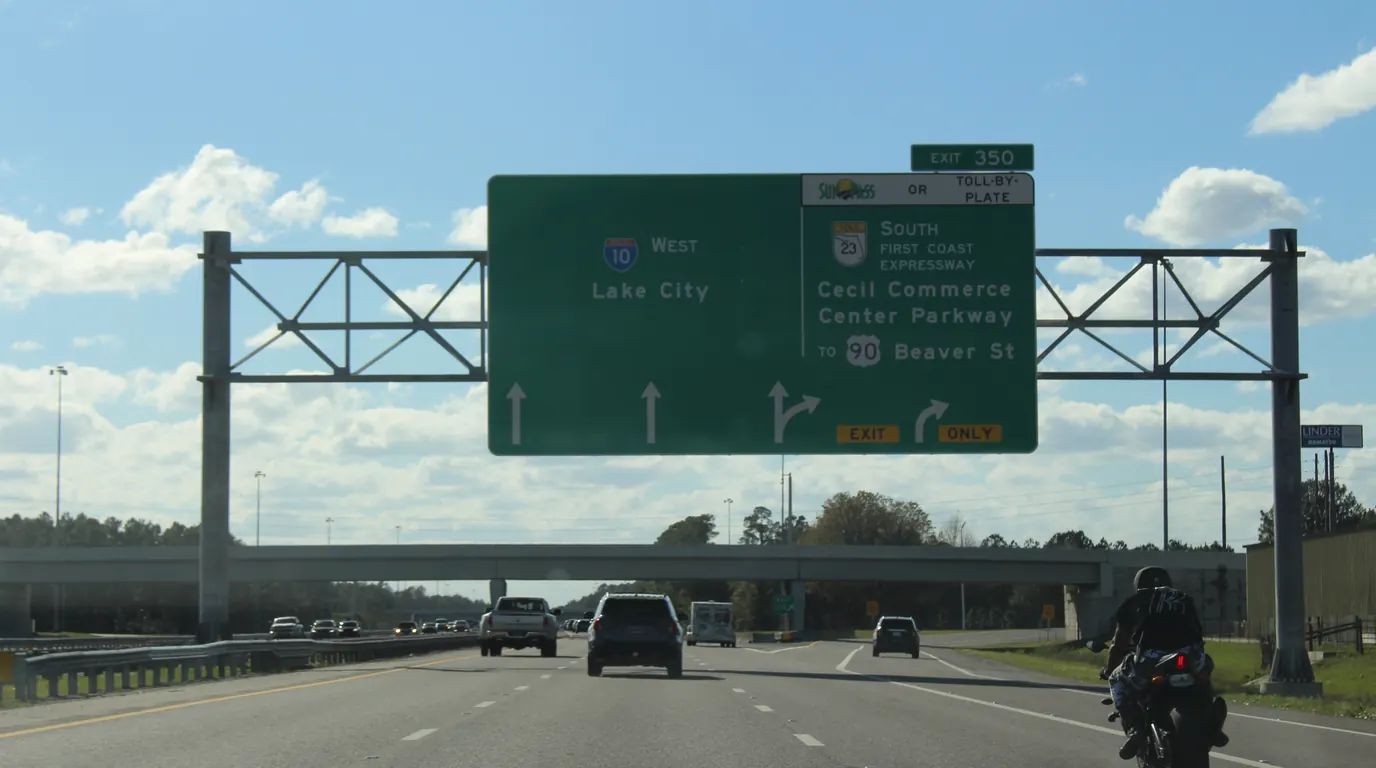
Your first time on the highway on a motorcycle
You’ve spent months riding your motorcycle around town and on back roads. City streets don’t scare you anymore, but every time the GPS routes you onto the highway, you look for the detour that adds forty minutes. You’re not alone. Merging for the first time into a lane where everyone’s doing 70 or 80 mph is intimidating, and that’s normal.
The good news is that the highway isn’t a test of courage. It’s an environment with very predictable rules: no traffic lights, no cross streets, no cars backing out of a driveway. Almost everything that surprises you out there can be anticipated with a little preparation. This guide pulls together what you need to know before the first time, what to do on the pavement and what changes if you cross the border.
The short version: Practice speed on faster roads with light traffic before your first highway · Use ALL of the acceleration lane to merge at the speed of traffic · Leave at least 2 seconds of following distance, and more in bad weather or behind trucks · Stay out of big rigs’ blind spots · Stop to rest every 1 to 2 hours, even if you feel fine
When you’re really ready for the highway
There’s no magic number of miles or kilometers for it. There are clear signs, though. You brake with both hands without thinking about it, you change lanes with a look over your shoulder, and you don’t freeze if a car cuts you off. If you’re still thinking through every shift, keep practicing; the hard part isn’t the riding itself, it’s doing several things at once at high speed. In Motorcycle confidence you’ll find braking and cornering drills worth mastering first.
Let me tell you about my first time getting on the highway in the U.S. It took me a while to make up my mind, but since it’s a step you have to take, I asked friends for help, information and advice. First, I picked a weekend day, early, to avoid traffic. I asked one friend to follow me by car, just in case, and another to ride ahead as a kind of shield, and we coordinated over the phone (through the intercom in my helmet). My goal was to get on the freeway, ride a couple of exits, turn around and do the same thing on the way back. It’s not about going far: it’s about the difference between riding on the highway and riding on city streets. In the end there were no surprises, and little by little, that’s how I trained myself to ride on U.S. highways.
Another good option is a four-lane road with a 55 to 65 mph limit. That’s where you get used to the wind noise and to the push of trucks as they pass you. If you haven’t taken a course yet, the MSF course or your state’s equivalent helps a lot; we cover that in Getting started.
Can your bike handle 70 or 75 mph comfortably?
Just because a motorcycle can reach a certain speed doesn’t mean it can hold it comfortably. A 250 or a 300 can get to 75 mph with the engine near its limit, with no reserve for passing and with tiring vibration. Before you head out, ask yourself these questions:
- Can you hold 70 mph at less than three-quarter throttle and still accelerate to get out of a tight spot?
- How much does it vibrate at those revs? If your mirrors are a blur or your hands go numb within 20 minutes, it’s going to be a long ride.
- Do you have any wind protection (a windscreen or a fairing)? Without it, your neck and shoulders pay the price.
- Are your brakes and chain (or final drive) in good shape? At high speed there’s no margin for a worn part.
If yours is borderline, start with short stretches.
And if you want to see what a bike designed to spend hours on the highway looks like, with a windscreen, a fairing and an engine that barely vibrates, take a look at our history of the Honda Gold Wing.
Tires and pre-ride check
Your tires are your only contact with the pavement, and they heat up at sustained speed. Check the pressure cold with your own gauge, following the motorcycle manufacturer’s label, not the maximum number molded on the tire. Look at the wear, check for nails, cracks or bulges, and verify the manufacture date: the four digits at the end of the DOT code tell you the week and year, and an old tire hardens even if it looks new.
Round out the check with oil, lights, chain and brakes.
Route and time of day
Plan your route before you set off and keep it in your head, not just on your phone. Know where the exits, gas stations and rest areas are. Pick a time with light traffic: between mid-morning and mid-afternoon on a weekday, or early on a Sunday, is usually calmer than rush hour. Avoid riding straight into the setting sun, and check the wind and rain forecast. For your first time, choose a 30- to 60-minute route with an exit close by in case you need to bail out.
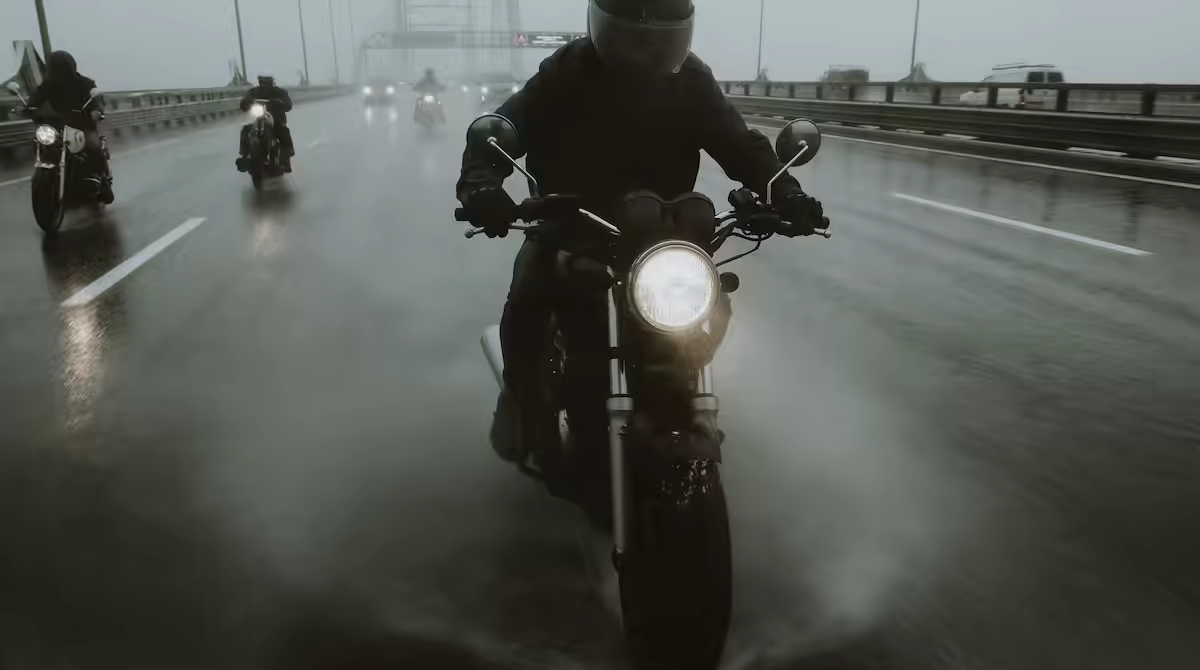
How to merge onto the highway: use the whole acceleration lane
Merging is the moment that stresses new riders the most, and it comes down to one simple rule: the acceleration lane exists so you reach the speed of traffic before you blend in. Use all of it.
- Watch the traffic while you’re still on the ramp. Look for a gap early.
- Accelerate firmly down the lane, not timidly. Entering at 40 mph into a lane where everyone’s doing 70 is what causes the close calls.
- Check your mirror, turn your head to check your blind spot and match your speed to the gap.
- Signal early and change lanes smoothly, without cutting anyone off.
- Cancel your turn signal and settle into your position.
If the gap doesn’t come, don’t force it: adjust your speed on the ramp and, if there’s really no room, it’s better to stop on the shoulder at the end and wait than to force your way in.
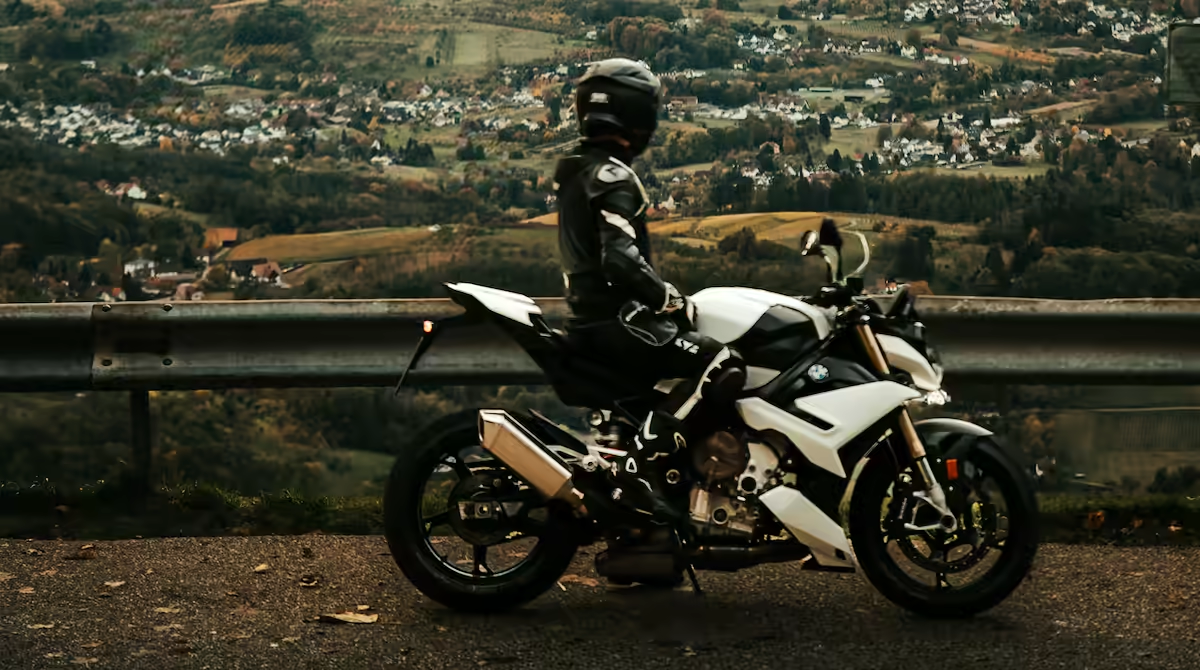
Lane position on the highway
You don’t always have to ride in the center of your lane. The MSF and state rider manuals teach you to choose among three positions depending on what’s happening around you: left, center and right. On the highway, the left or center of the lane usually gives you more visibility and more room from vehicles merging on the right. In the rain, try not to ride right on the center strip, where the residue dripping from cars builds up.
Adjust your position all the time: move away from a car riding on the line, give room to anyone merging and don’t sit in anyone’s blind spot. The idea isn’t to hug one side, but to keep escape options open.
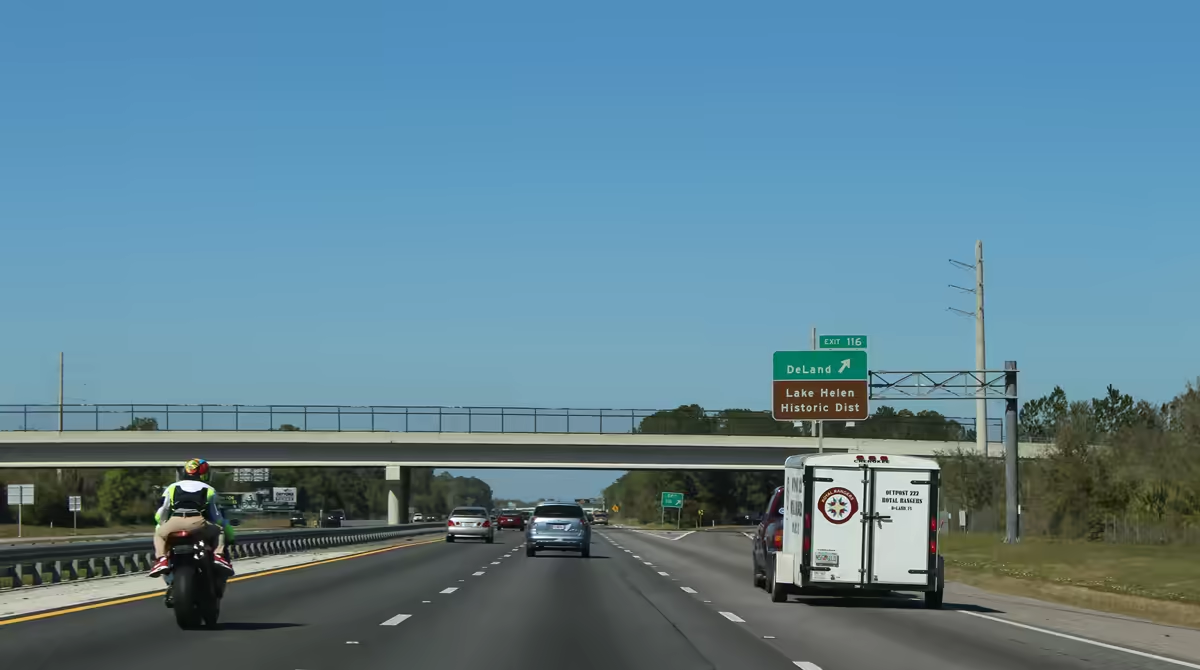
Following distance: the 2-second rule
The most widely used reference comes from the Motorcycle Safety Foundation: a minimum of two seconds of following distance, which its group riding materials specifically mention for getting on and off highways. The MSF presents it as a minimum, not a target. To count it, pick a fixed point on the road (a pole, a sign), and when the vehicle ahead passes it, count “one thousand one, one thousand two.” If your bike gets there before you finish, you’re too close.
Increase the margin to three or four seconds in the rain, at night, in the wind, on damaged pavement, behind a truck kicking up rocks or when you’re tired. It takes longer to react and brake when all of that adds up. At 70 mph you cover more than 100 feet per second, so two seconds is more than 200 feet; that’s where the time that saves you is.
Also look past the car in front of you: brake lights three or four vehicles ahead warn you sooner.
Semi trucks: blind spots and turbulence
Big rigs are part of the highway landscape, and it pays to know how to read them. The Federal Motor Carrier Safety Administration (FMCSA) talks about “No-Zones,” the areas around a truck where the driver can’t see you or where you have no room to react: right in front, close behind and along the sides, with the one on the right being the largest. The approximate figures that get passed around are about 20 feet in front and about 30 behind, but we couldn’t confirm them on an official FMCSA page, so take them as a ballpark. Personally, when I’m on the highway, I try to stay as far away from large vehicles as I can, especially those carrying a load in the bed, like pickups, because something could come flying off.
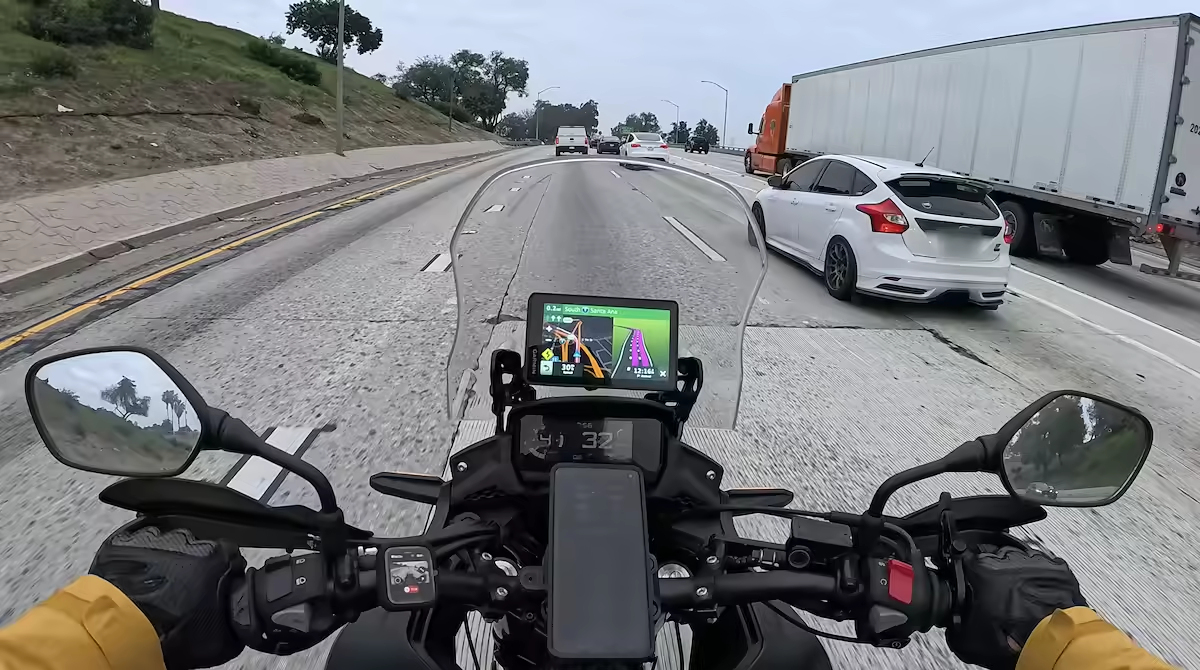
The practical rule is different and doesn’t depend on numbers: if you can’t see the truck’s mirrors, the driver can’t see you.
What that means on the highway:
- Don’t ride alongside a truck. Pass it decisively or stay well back.
- Pass on the left when you can, and don’t move back into the lane until you can see the front of the truck in your mirror.
- Leave more distance behind a truck: it protects you from rocks, blown tires and sudden braking.
- Before you pass, get ready for the change in air. As you go by, the turbulence off the cab first pushes you away and then pulls you in. Hold the bars firmly, keep your arms relaxed and don’t make abrupt corrections.
Crosswinds and gusts
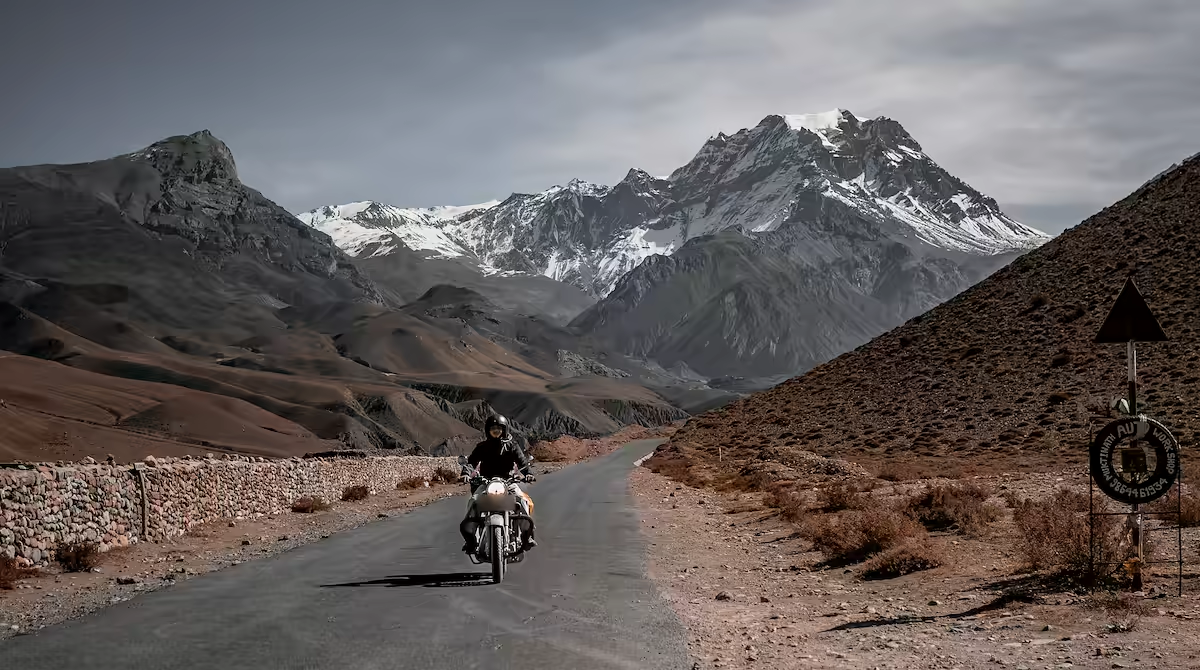
Crosswind is the silent enemy. On bridges, through gaps between hills and on open plains, a gust can push the bike half a lane over. Keep your hands relaxed, look far ahead and let the bike settle. If strong gusts are in the forecast, sometimes the best decision is to postpone. And when you do feel that shove from the wind, don’t panic and correct as soon as you can; slowing down can help in these cases. Where it pushes you depends on the road: on a freeway, traffic in each direction is separated by a median or a barrier, so a gust can move you into the next lane or onto the shoulder. But a highway can also be a two-way road divided only by a double yellow line, and there a gust can push you into the oncoming lane, head-on into traffic.
Fatigue, hydration and rest stops on long rides
When the highway gets monotonous, the monotony puts you to sleep faster than you think. Your body starts warning you with a stiff neck, a fixed stare and a blank mind. Then the mistakes show up: you miss your exit, you creep too close to the car ahead. And if you add the weather on top of that, like the sun beating down right in your face, you’re just pushing your luck and risking the whole trip because you didn’t want to stop.
Consider setting some sensible guidelines: stop every hour or two, or sooner if you feel uncomfortable. At every stop you make, I recommend:
- Drink water, even if you’re not thirsty. With the wind and your gear on, dehydration creeps up without warning.
- Stretch your neck, shoulders, wrists and lower back.
- Eat something light. A heavy meal makes you sleepy, especially carbs like pasta.
- Look the bike over: the tires, the chain and whether your luggage is still strapped down tight.
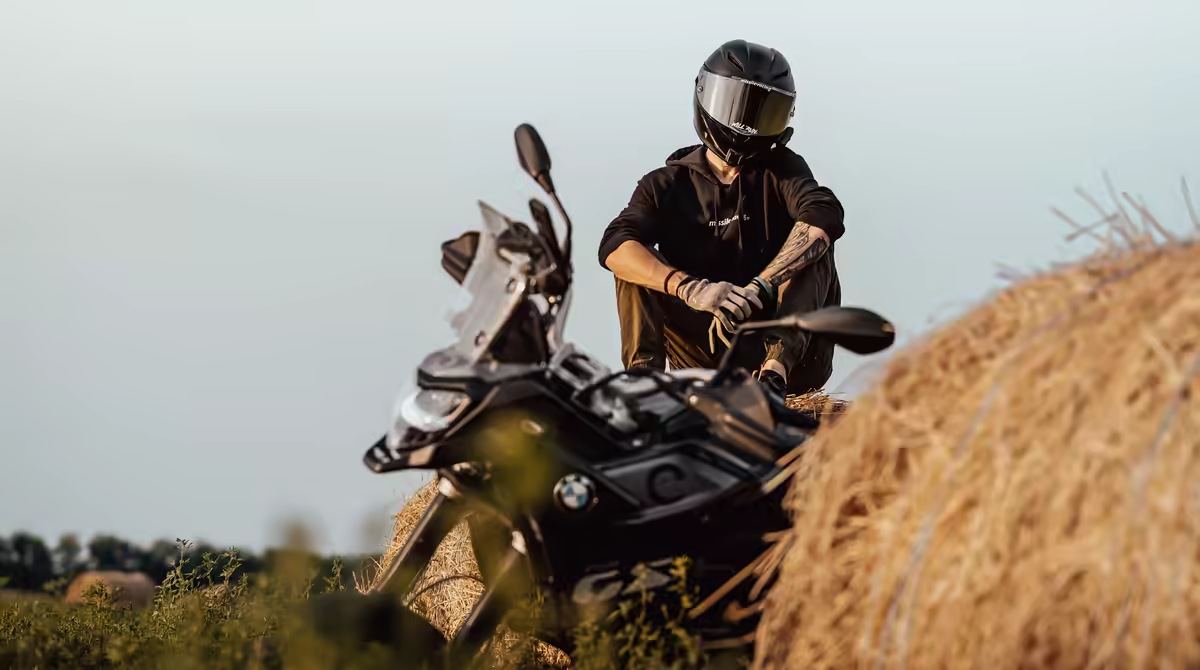
My personal advice: if at any point you notice you’re nodding off, your eyelids feel heavy, you’re changing pace without meaning to or you can’t remember the last few miles, get off at the next exit and take about 20 minutes to clear your head. Believe me, no arrival time is worth putting yourself at risk. In the heat, wear a vented jacket instead of taking off your protection. And for any long trip, Solo motorcycle road trip has more on packing and planning.
Is the highway safer than city streets?
It’s common to hear that “the highway is safer than the city.” We couldn’t find an official NHTSA, IIHS or FHWA figure comparing road types, so we won’t claim it. What we do know is that, according to NHTSA’s fact sheet with 2024 data, per mile traveled, motorcyclists are nearly 27 times more likely to die than passenger car occupants, and speed makes any crash worse. That’s why it’s full gear and a certified helmet, every mile.
Highways in the U.S. and Mexico: what changes
United States
- Electronic tolls. Many toll roads use transponders (E-ZPass, SunPass, TxTag and others) and toll-by-plate billing. The readers were designed with cars in mind, and on a motorcycle the usual approach is to carry the transponder in a mount or in your jacket pocket; check the policy of the agency that runs the road you’ll be using.
- HOV lanes. Federal law (23 U.S.C. § 166) says authorities must allow motorcycles to use high-occupancy vehicle lanes, even if you’re riding alone. The exception: a state can restrict them if it certifies a safety risk and the Department of Transportation accepts it after publishing a notice in the Federal Register. You can read the text of the law. Even so, check the signs and the rules of the state you’re riding in.
- Lane splitting. Whether you can ride between lanes depends on the state, so check the law where you ride. We explain it in motorcycle laws on emissions, noise and lane splitting.
Mexico
- Toll highways. Toll roads (autopistas de cuota) are usually in better shape and better patrolled than the free roads (libres). At the toll booths, the IAVE electronic toll system and other compatible TAGs have been expanding, and there have been announcements that cash payment will be phased out of more lanes. Check the IAVE portal to see whether your TAG works for motorcycles and which rate applies to you, because motorcycles usually pay less than cars and it’s worth confirming the current rate. Carry backup cash, just in case.
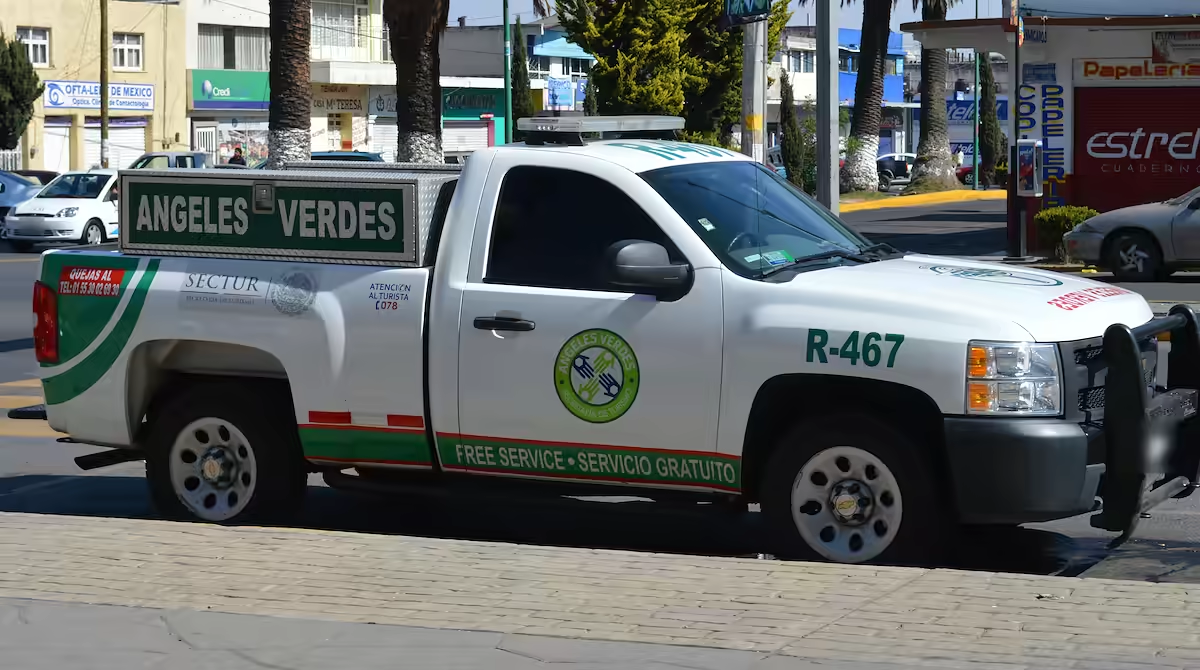
- Ángeles Verdes. The “Green Angels” are a free service from Mexico’s Ministry of Tourism (Sectur) that provides roadside mechanical help and travel information. You can reach them at 078 or through their mobile app. Published hours have varied from source to source, so check Sectur’s official page before you go. Save the number in your phone.
- Units. Speeds and distances there are in kilometers. Limits change from one stretch to the next, and potholes or loose animals can turn up even on a toll road.
Quick checklist before your first highway ride
- Bike checked: tires, brakes, oil, chain, lights.
- Full gear: certified helmet, jacket, gloves, pants and boots.
- Route, exits and stops planned; enough fuel.
- Water within reach and a plan to take a break every hour or two.
- Wind and rain forecast checked.
- Phone charged and emergency numbers saved (in Mexico, 078 for the Ángeles Verdes; in the U.S., 911).
Frequently asked questions
What’s the difference between a freeway and a highway?
In the U.S., a freeway is a divided highway with full control of access: you only get on and off by ramps, there are no traffic lights or cross streets, and the two directions are separated by a median or a barrier. That’s how the FHWA’s Manual on Uniform Traffic Control Devices (MUTCD) defines it. Highway is a broader term for any public road: it can be a freeway, but it can also be a two-way road with intersections and driveways. In Mexico, the closest thing to a freeway is an autopista with the directions separated; carretera is the general term, like highway.
How many miles do I need before riding on the highway?
There’s no official minimum. What matters is being in control of your braking, lane changes and cornering, and having ridden on faster roads with light traffic.
Can I do 75 mph on a 250 cc motorcycle?
Some will get there, but with no reserve for passing and with vibration. If that’s your bike, ride in short stretches with frequent stops. And if you’re still choosing a bike, our guide to the best motorcycles for beginners compares options.
How many seconds of following distance should I leave?
The MSF says two seconds at minimum. Increase it to three or four in the rain, at night, in the wind or behind trucks.
Can motorcycles use HOV lanes?
Federal law requires it, unless the state certifies a safety risk and the Department of Transportation approves the restriction. Check the state’s rules and the signs on that stretch.
What number do I call for the Ángeles Verdes?
078, free of charge. You can also use their mobile app. Confirm the current hours on Sectur’s official site.
How often should I stop on a long ride?
A reasonable guideline is every one or two hours, or sooner if you feel stiff, hot or tired. Drink water and stretch, even if you feel fine.
Take it easy
You’ll remember your first highway ride for the rest of your life, so make it a good memory. Get the bike ready, pick a quiet time of day, use the whole acceleration lane and don’t be shy about stopping. After a few rides, what looks like a wall of cars today will be just another road you know how to read.
Photos
Cover: Michael Rivera, via Wikimedia Commons · CC BY-SA 4.0 · cropped.
Photo 1: cottonbro studio, via Pexels · Pexels License.
Photo 2: Cedé Joey, via Pexels · Pexels License.
Photo 3: Michael Rivera, via Wikimedia Commons · CC BY-SA 4.0 · cropped.
Photo 4: the author’s personal archive.
Photo 5: Beepin4, via Pexels · Pexels License.
Photo 6: Marius Gabriel, via Pexels · Pexels License.
Photo 7: Alejandro Linares Garcia, via Wikimedia Commons · CC BY-SA 3.0 · cropped, license plates blurred.


